MAPPING THE MORE-THAN-HUMAN THROUGH PERFORMATIVE ZINE MAKING
THE HAUNTOLOGICAL FIELD GUIDE TO REWILDING FOR ANYONE & ANYWHERE
Lissie Carlile
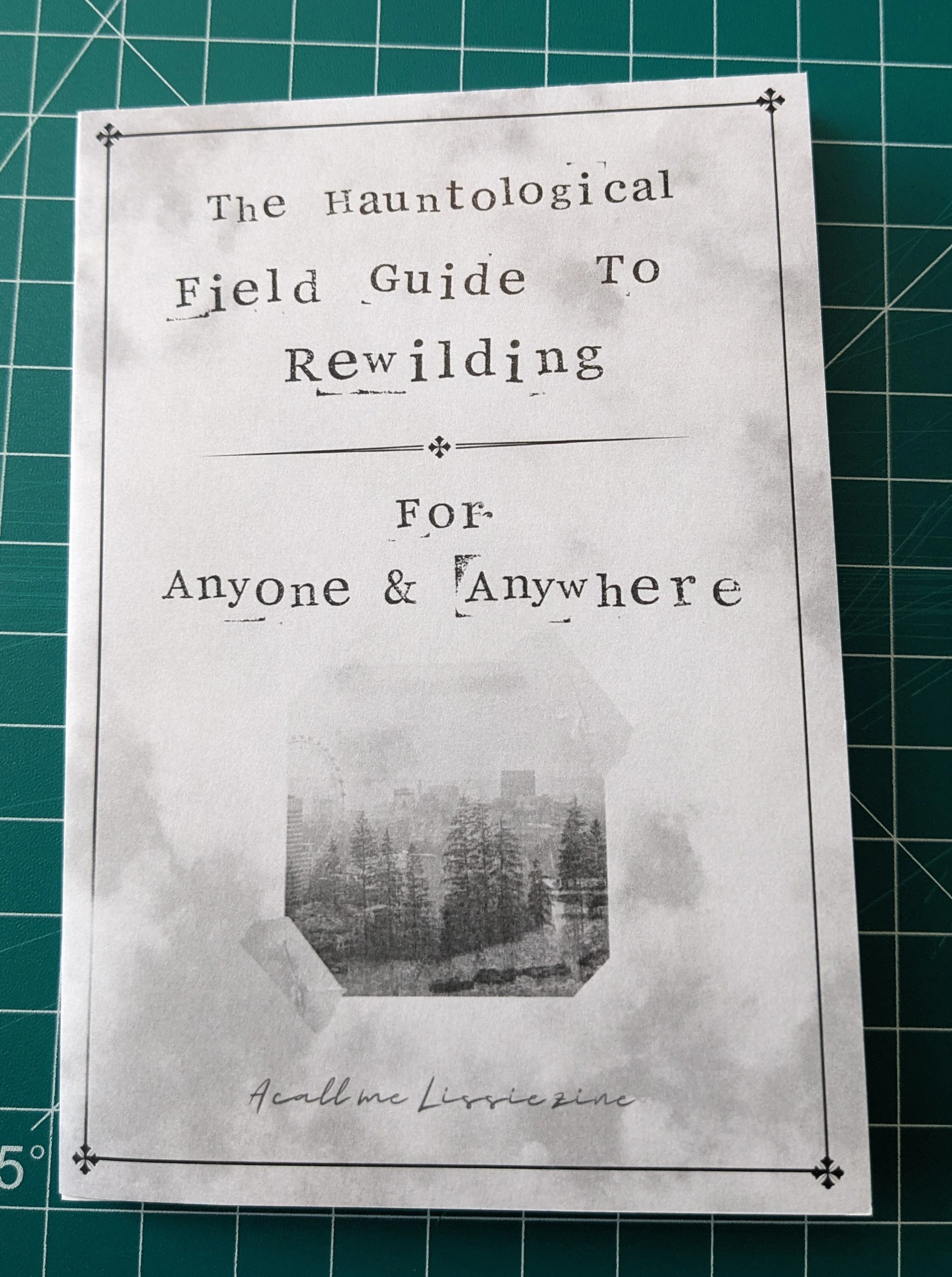
Front page of zine
The landscape is haunted…not by pretend ghosts in white sheets, but by something harder to see - the lingering presence of what should be here but isn’t. The missing species, the lost habitats, the rhythms of an ecology that once flourished, are all now buried beneath concrete. Like all ghosts, these have not fully disappeared but still hover at the edges of perception just waiting for you to pay attention and notice them.
We know hauntology as a spectral persistence of lost futures and the sense that something that is absent can still exert an influence. What if hauntology applies not only to this lingering sense of absent time, but also to our lost ecologies?
What if the landscape itself is haunted, not just by human memory, but by spectres of creatures that once thrived? The songbird that no longer sings at dawn, the wolf whose shadow once flickered through the undergrowth, the meadow that is now a supermarket car park.
Rewilding is often framed as a practical activity in reintroducing species, restoring habitats and letting the land regain in its own wild logic. Can we not also consider rewilding as an act of summoning?
We are trained to see cities as separate from nature, to think of extinction as final and irreversible. But what if our internal senses, our ability to detect what is missing, to feel the weird presence of the absent, could guide us towards a different relationship with our environments?
What if we allowed ourselves to be haunted by extinct species? A haunting that we allow not through a sense of despair, but in a way that reactivates our perception of nature through our imagination. What if we learn to recognise the invisible traces of lost ecosystems and use them as a map for rewilding?
To rewild is to call these ghosts back into being. And the first step is not to action, but to notice.
Excerpt from The Hauntological Field Guide to Rewilding Anyone & Anywhere Zine
Field guides aim to record a landscape alive with presence: species to be identified, behaviours to be catalogued, habitats to be described. Yet with current climate chaos leading us to frequently consider the ever-expanding list of species facing extinction, or the loss of landscapes, there may be a need to consider how a field guide can begin to confront absence.
The Hauntological Field Guide to Rewilding for Anyone & Anywhere Zine (herein referred to as The Hauntological FG Zine) encourages a participatory approach to considering the spectres of more-than-human entities that are now absent from contemporary landscapes. Informed through a workshop conducted at the Livingmaps Network More-than-human Mappings conference (April 2025), this reflection considers how zine-making as a performative methodology can be used for cartographic inquiry. Readers/participants are invited to think about what/who haunts contemporary landscapes as an approach to recognising the presences which still echo in cultural memory, even if not in ecological fact. These ‘landscapes are radical tools for decentring human hubris…[they] are not backdrops for historical action: they are themselves active’[1] and provide sites for more-than-human worlds. As outlined by Tsing within the 2015 text The Mushroom at the End of the World[2], more-than-human worlds are created through an assemblage of varied species which influence each other and come together as human/non-human and living/non-living. This zine considers, in response to these more-than-human worlds, the creative practice of mapping an ‘art of noticing’[3] by attending to absence, learning to ‘grieve-with’[4] those already extinct and foster relational ‘response-ability’[5] in our approach to rewilding.
Process and Practice
The zine provides agency for ‘anyone’ to engage with their ‘anywhere’ habitat. The Hauntological FG Zine differs from traditional DIY zine making in which creators start with a blank piece of paper and build their document through a series of assembling; layering found material, handwritten text, drawings and cut-and-pasted imagery. Instead, pre-determined activities that are detailed in The Hauntological FG Zine encourage those engaging with it to become both a reader and participant as they document their playful interactions through use of the document itself. As such, they are mapping both their experience and environment in the zine.
Attendees at the More-than-human Mappings conference were invited to step outside of the Senate House building in London, taking a copy of the zine along with them. Firstly, they were encouraged to wander aimlessly for a short amount of time, perhaps stopping when they felt inclined to do so. The readers/participants were then guided to take a moment of reflection through gentle prompts in the document and encouraged to think about what or who may be found as an entangled eco-spectre.
Some found themselves situated on the pavement, between the buildings either side of Malet Street; or in a green space around the corner known as Gordon Square; others still within the grounds of university buildings. No matter where each person landed, their interaction with the zine created a unique response.
Observation Task - High Definition Viewing:
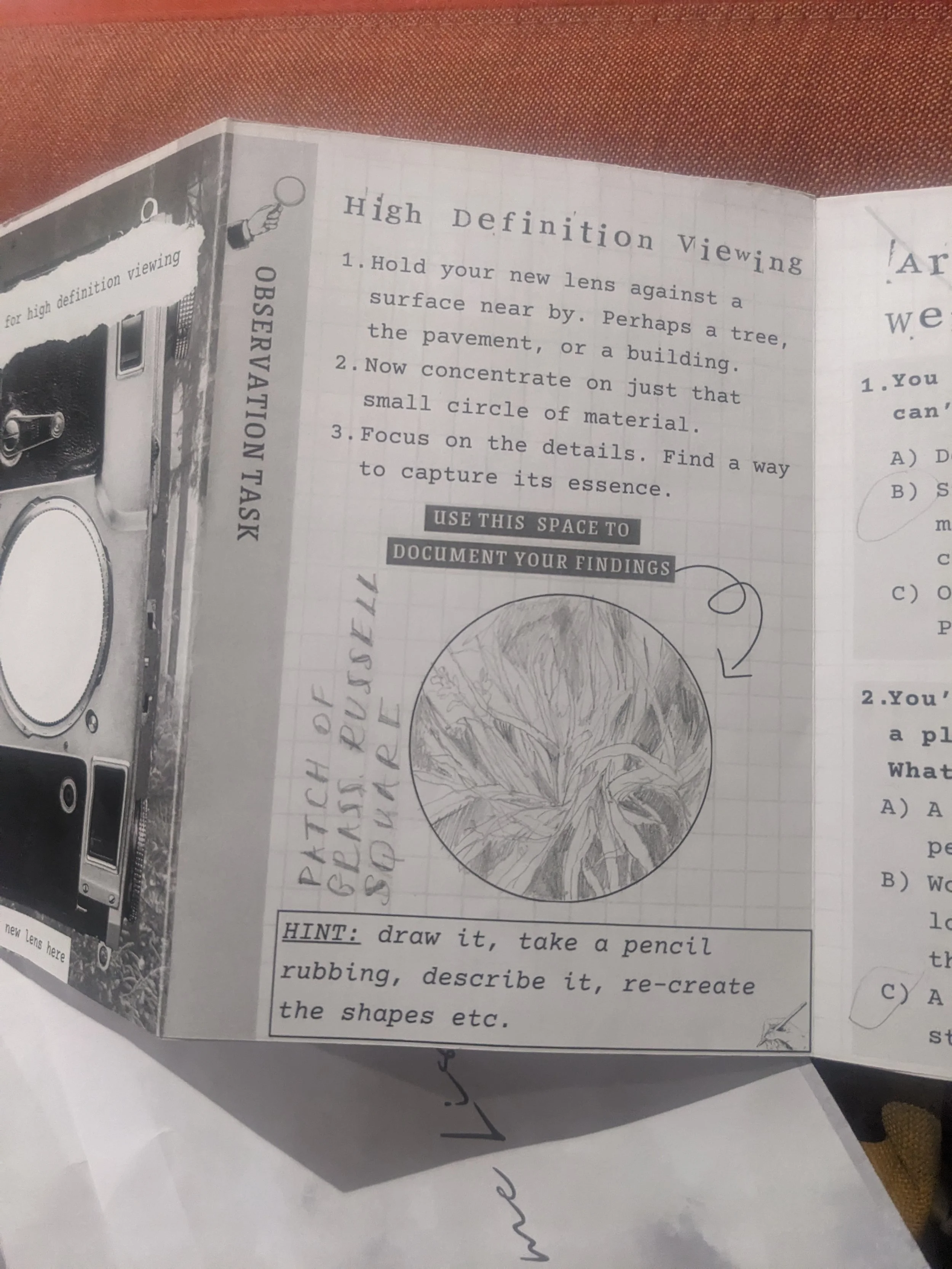
High Definition Viewing task, with zine camera at left
Having cut out a new lens from their zine camera, readers/participants held the document to a nearby surface and viewed the material behind, through the small, cut circle, zooming in on a specific area of their current environment. The task invited individuals to try and capture the essence of what could be found within the circle. Encouraging people to think creatively about how we might document a location within a very small area returned some interesting interactions. One person had taken a pencil rubbing of the wall they leant against, finding a way to map the textures of their location, whilst another recorded their emotional response through prose.
Upon readers/participants return, we discussed how the zine document itself had started to integrate with the location. Placed against a granite bench, the greyscale zine was camouflaged, becoming part of the environment. Whereas another reader/participant placed their zine lens on the ground of the park they sat in and made note of the stark contrast between the green grass and grey paper. These observations began to demonstrate an ability to frame unique perspectives within one geographical location.
Identification Task - Are You Becoming Weird Or Eerie?:
The second task asked the reader/participant to use ‘Identification’ as a moment of reflection in which they were prompted to consider their internal sense of the ‘weird or eerie’[6] in relation to haunted landscapes. The reader/participant classified themselves into one of three categories as below, by answering a series of multiple-choice questions:
Solidly Mundane: You may sense oddness now and then, but you rationalise it away. If a spectre knocks on your door, you don’t answer.
Threshold Haunting: You seem to notice things others don’t. Strange coincidences, empty spaces that don’t feel too empty, a light which flickers in the darkness. You are beginning to listen to the world. Be careful – it is listening back.
Fully Haunted: You are no longer separate from the weird and the eerie – you are becoming part of it. You can recognise the ghosts in the landscape. It’s up to you to welcome them back.
Excerpt from The Hauntological FG Zine
This playful quiz-like interaction evokes a relationship between the individual and their internal ability to acknowledge now missing species. Considering a personal sense of the weird and eerie begins to map the individual’s journey to understanding how to ‘grieve-with’ the species that are no longer found within local landscapes – reminding individuals of the importance of acknowledging the spectral presences that may still be lurking within our chosen environments.
Imagination Task - Forgotten Traces:
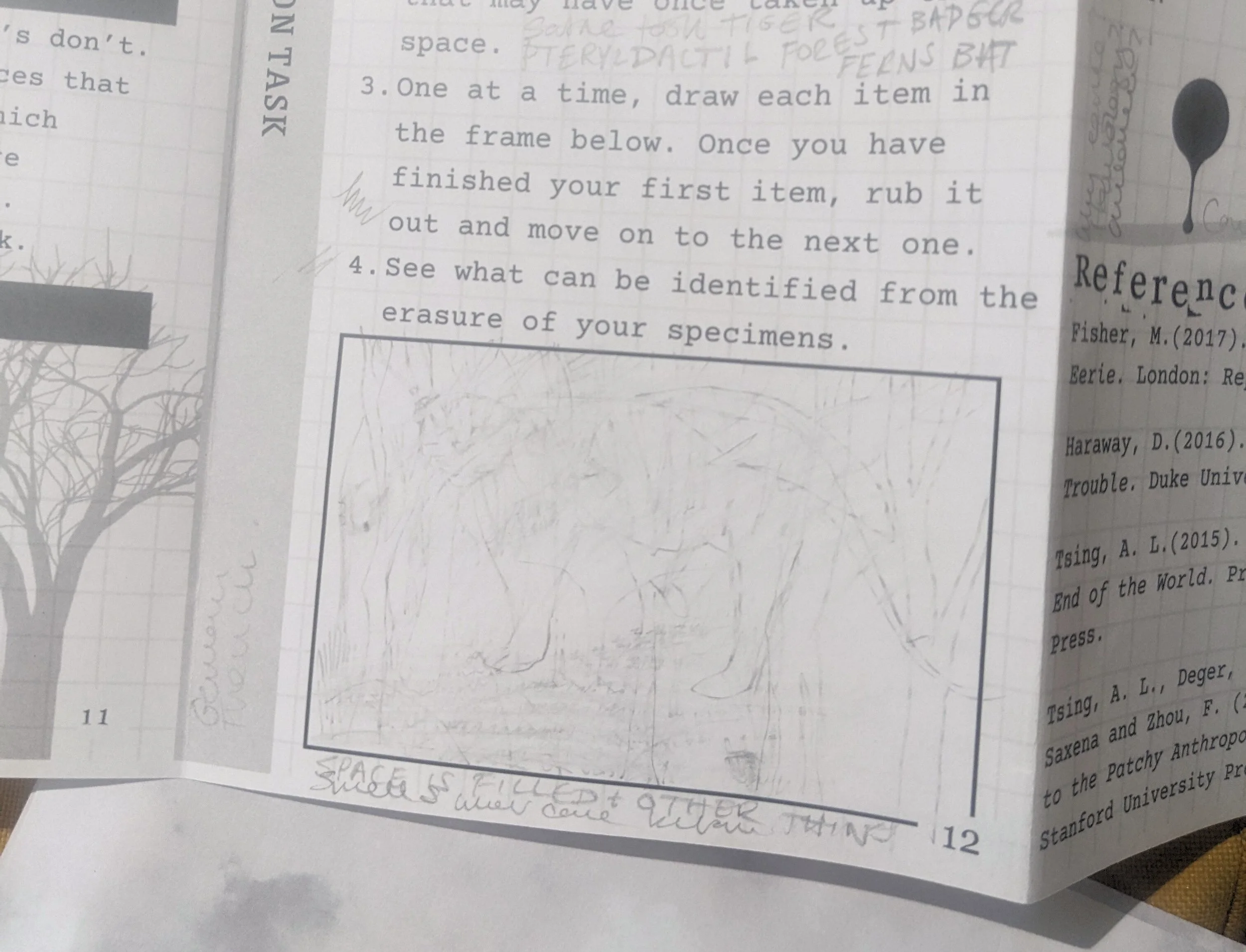
Forgotten Traces task
With readers/participants now thinking about potential spectral presences, the third task invited creative response and imaginative documentation of the ghosts embedded in the landscape. Readers/participants were encouraged to think about the species that may have once existed in their chosen environment - dinosaurs, fern plants, insects, oak trees, cattle etc - and record within their zine frame the creatures and critters they thought were missing. The zine prompted this documentation moment through drawing, but readers/participants were welcome to use the space however they chose. Each species was then rubbed out, and another more-than-human figure invited to be drawn in the same space. Although each creature was erased, the memories remained on the page through the echoes of former pencil markings and eraser rubbings, forming a spectral layering and documenting a memorial practice. The pocket size document is not only an easy to carry around field guide, but tangibly demonstrates the accumulation of changes within the landscape, as the small section of paper is used and re-used to document the more-than-human species no longer present. The undertaking is almost insurmountable. This task opens out opportunity to approach lost species identification through a speculative practice instead of accessing knowledge only through scientific fact.
The Art of Noticing Task - Response-able Rewilding:
Finally, The Hauntological FG Zine reminded the readers/participants that to approach rewilding, there must be care given to more-than-humans. By building a relationship with a very small, local environment through the process of the zine tasks, individuals were encouraged to push their relationship with the missing further. To take the time to notice and care about what may have once flourished in the same environment they sat in, provides opportunity to think beyond the human. Informed through Haraway’s writing on kin-making[7] this project relies on the individual’s commitment to engage with more-than-human species through response-able approaches. By the end of the walk, The Hauntological FG Zine exists as a map documenting the individual’s moments of attentiveness in speculative re-imaginings and real-world interactions with their more-than-human entanglements.
Final Considerations
The Hauntological FG Zine embeds the participant within a practice of witnessing the more-than-human worlds that persist in precarious conditions. The combination of tasks draws on ‘different knowledge practices – different modes of attentive immersion’[8] in order to encourage an experience between the reader/participant and the liminal space they take up. By documenting these experiences within the zine, each response becomes reflective of participants’ ‘own very particular histories and possibilities’[9], thus mapping not only the local environment, but the internal interaction with liminal landscapes. Following the workshop conducted as part of the More-than-human Mappings conference, the reflections from this zine process will inform a larger PhD inquiry into the entanglements between humans/non-humans and their haunted landscapes which demonstrate disappearance/re-appearance through both extinction and conservation efforts. By spending time reflecting on what or who is now missing from certain environments, there is scope to consider how kinship may look through rewilding processes.
The zine emerges as a speculative cartography. As readers/participants have engaged with an art of noticing, they have faced the grief, loss and vulnerability that occurs when mapping the already extinct. Considering the spectres of the more-than-human species that once existed in these spaces has, however, prompted ways of finding how to care and co-exist with others. Even in situations that feel beyond repair, The Hauntological FG Zine demonstrates a speculative approach to rewilding spectres anywhere, and by anyone.
Notes
1. Tsing, A. (2015). The Mushroom At The End Of The World: On The Possibility Of Life In Capitalist Ruins. Princeton: Princeton University Press. (p. 152)
2. Tsing. The Mushroom At The End Of The World.
3. Tsing. The Mushroom At The End Of The World.
4. Van Dooren, T., Kirksey, E. and Münster, U. (2016). Multispecies Studies: Cultivating Arts of Attentiveness. Environmental Humanities, [online] 8(1), pp.1–23. https://doi.org/10.1215/22011919-3527695.
5. Haraway, D. (2016). Staying with the Trouble: Making Kin in the Chthulucene. Durham: Duke University Press.
6. Fisher, M. (2016). The weird and the eerie. London: Repeater Books.
7. Haraway. Staying with the Trouble.
8. Van Dooren, T. et al. Multispecies Studies.
9. Van Dooren. T. (2016). Flight ways: life and loss at the edge of extinction. New York: Columbia University Press.