A Cultural Mapping of Equity, Diversity, and Inclusion in a Canadian School
One Student’s Research Journey
Jayse Heer-Matonovich, W.F. Garrett-Petts, and Jonathan Brady
University of Ottawa, Thompson Rivers University, and Sa-Hali Secondary School
The last twenty years have seen a profound interest in the cartographic, especially among humanists and social scientists, with cultural mapping now recognized as an emerging field of multidisciplinary academic inquiry and community development practice (Duxbury et al, 2015; Rossetto & Lo Presti, 2024). Urban planning, cultural development, and cultural sustainability work has turned to cultural mapping as an effective, highly participatory method of making visible the ways local stories, practices, relationships, memories, and rituals constitute places as meaningful locations (Abrams & Hall, 2006[2]; Bryan, 2011[3]; Caquard, 2013[4]; Crawhall, 2007[5]; Gerlach, 2010[6], 2014[7]; Guldi, 2017[8]; Hunter, 2019[9]; Kerski, 2014[10]; Kitchin & Dodge, 2007[11]; Roth, 2009[12]). During this same period, but working with a more localised school-based agenda, Wood and Lemley (2015)[13] introduced their own, highly original project, Mapping Cultural Boundaries in Schools and Communities. Here, the focus was pedagogical, on helping students locate and negotiate their cultural identities. They asked middle school and high school students to map spaces in their schools and communities that they found “open and inclusive of their cultures or spaces where their cultures are excluded” (p. 1). The student mapping was elaborately facilitated by teachers and scaffolded by a critical pedagogy framework that drew upon the theories of Freire, Dewey, and Lefebvre, with the goal of “connecting students’ experiences to understanding how power and politics shape social inequities” (p. 4). The overall project, developed independent of the field concerns explored by cultural mapping scholars elsewhere, laid a potential groundwork for cultural mapping as a social practice for student empowerment.
Some key questions about this pedagogical cartographic turn were first posed by Vadeboncoeur and Hanif-Shahban (2015)[14] in their immediate and enthusiastic response to Wood and Lemley’s article. Inspired by the description of cultural mapping’s capacity for youth empowerment, they asked for further details about how the students were engaged, how perceptions of mapping changed over time and context, how relationships mediated participation, and how transformation in the participants, children, youth, and adults was manifested (p. 1). In essence, they were asking for a pedagogical research orientation that moved beyond the classroom assignment or project, recognising the potential to engage students in cultural mapping as a longer-term ethnographic process of community research engagement: We longed to see the dialogue,” they noted, “the interactions, the relationship building that occurred to create the final maps and the additional conversations with peers, teacher candidates, and teachers in schools that occurred as a result of the process (p. 2). That longing for a thicker description of the mapping persists to the present day, for, as Jankens et al. (2025) observe of cultural mapping research generally, readers don’t get to see in this scholarship the specific tools used to facilitate such activities on a smaller scale (Jankens et al., 2025, p.4)[15]
Similarly, and perhaps more consequentially, the capacity for youth empowerment has not been fully realised in the cultural mapping field or in examples of school-based mapping. Attention to forms of cultural mapping in schools has expanded over the last 10 years or so, with projects in decolonial and intercultural identity-mapping taking up other core questions about how mapping lets students see, position, and even contest their cultural identities within school settings and local neighbourhoods (Art of Belonging, 2026[16]; Burch, S., 2015[17]; Burke, A., and Boison, B., 2025[18]; Gordon, et al, 2016[19]; Heritage BC, 2026[20]; Jagger, S., 2016[21]; Lenny Learning, 2026[22]; PublicMap, 2026[23]; Pyne, S., et al, 2022[24]; University of Michigan, 2026)[25]. What unites this body of work, however, is also what constrains the work: the mapping process, largely classroom-based in orientation, continues to be too often detached from the theory and practices defining the larger field. It is valued for how teachers can support students’ self-understanding rather than for what students can produce as knowledge makers capable of informing, say, institutional culture and policy. Students map; teachers and researchers scaffold and interpret, but cultural and policy change tends to remain mostly aspirational or conjectural.
Although cultural mapping is designed to validate individual voices and experiences, student participants in school-based mapping research have remained more the subjects of inquiry than the agents of that inquiry. Yu, Han, and Ahn (2026)[26] note some progress, with a productive “turn to multimodal literacies” in recent research, with mapping positioned as “a flexible, child-driven process for composing identity and belonging” (pp. 1-2). Yet, even here, mapping is presented as more a mode of self-exploration than an introduction to a field of inquiry or as a vehicle for student knowledge production. We still need to consider what happens when students’ maps are treated not only as self-expressions of lived experience but also as credible knowledge with recognised research implications.
In this multimodal essay, we present Project EDI, both the project as initially conducted and our subsequent reflections, as our contribution to the pedagogical conversation initiated by Wood and Lemley. Employing a collaborative research design involving a student researcher lead, a university faculty mentor, and a high school principal, we have been working together now for over four years. We argue that Jayse Heer-Matonovich’s Project EDI provides a highly engaged, student-led response to the field’s call for increased transparency in terms of how cultural mapping actually works in practice. We include here a collaboratively written research narrative interleaved with Jayse’s visual autoethnography, which includes her original school project (presented below unedited), her video documentary (created as a critical reflection when she moved from high school to university), and a series of photographs and descriptive vignettes documenting Jayse’s subjective take on her research journey. It is, in that sense, at once a case study, a thick description, a methods account, and a demonstration of its own central argument: that when student researchers are well prepared, supported, and taken seriously, they can produce knowledge that is not only valid but empowering and genuinely difficult for institutions to ignore.
Project EDI
A Cultural Mapping of How Students and Teachers Experience Equity, Diversity, and Inclusion
Sa-Hali Secondary School Capstone Project
Jayse Matonovich
(Mentored by Dr Will Garrett-Petts, Thompson Rivers University)
Introduction
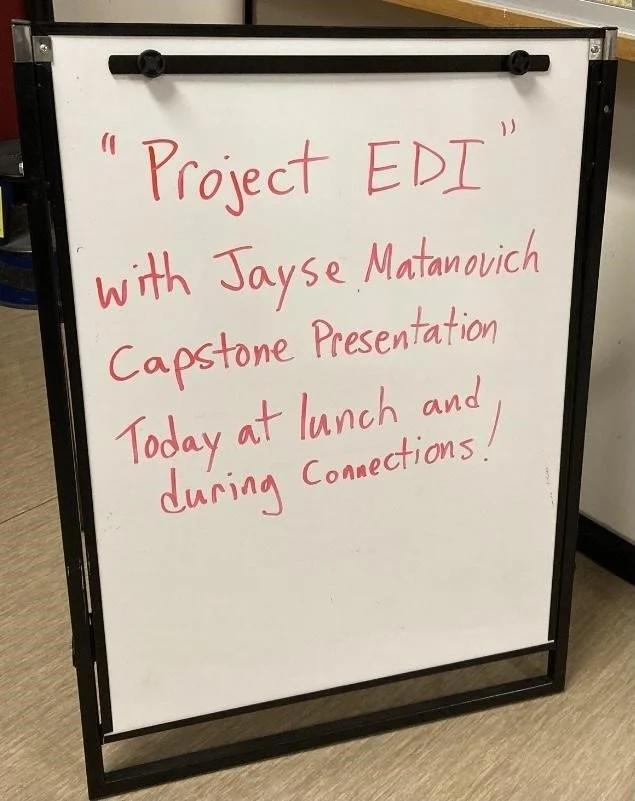
I am a grade 11 student, and as part of my Career 12 requirements, I am doing my capstone project on equity, diversity, and inclusion (EDI) at Sa-Hali, capturing the perceptions of staff and student experiences using cultural mapping methods
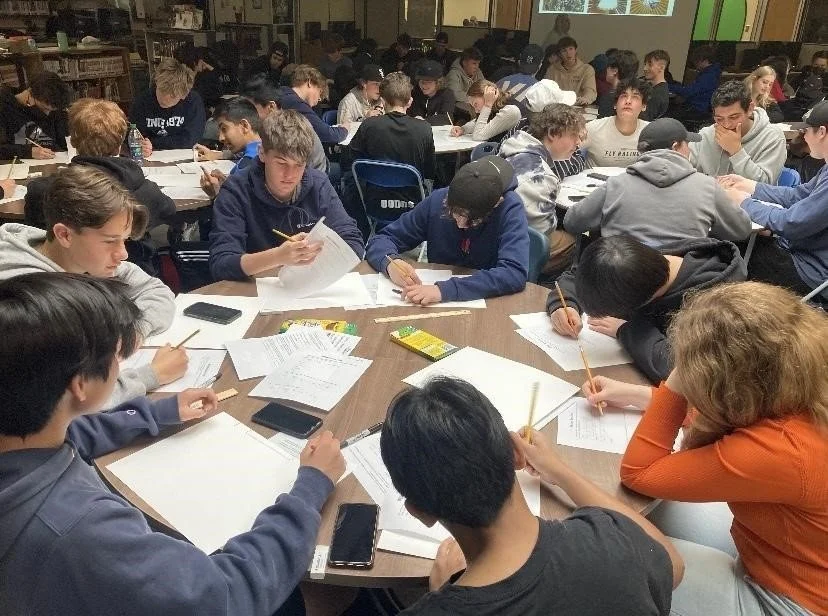
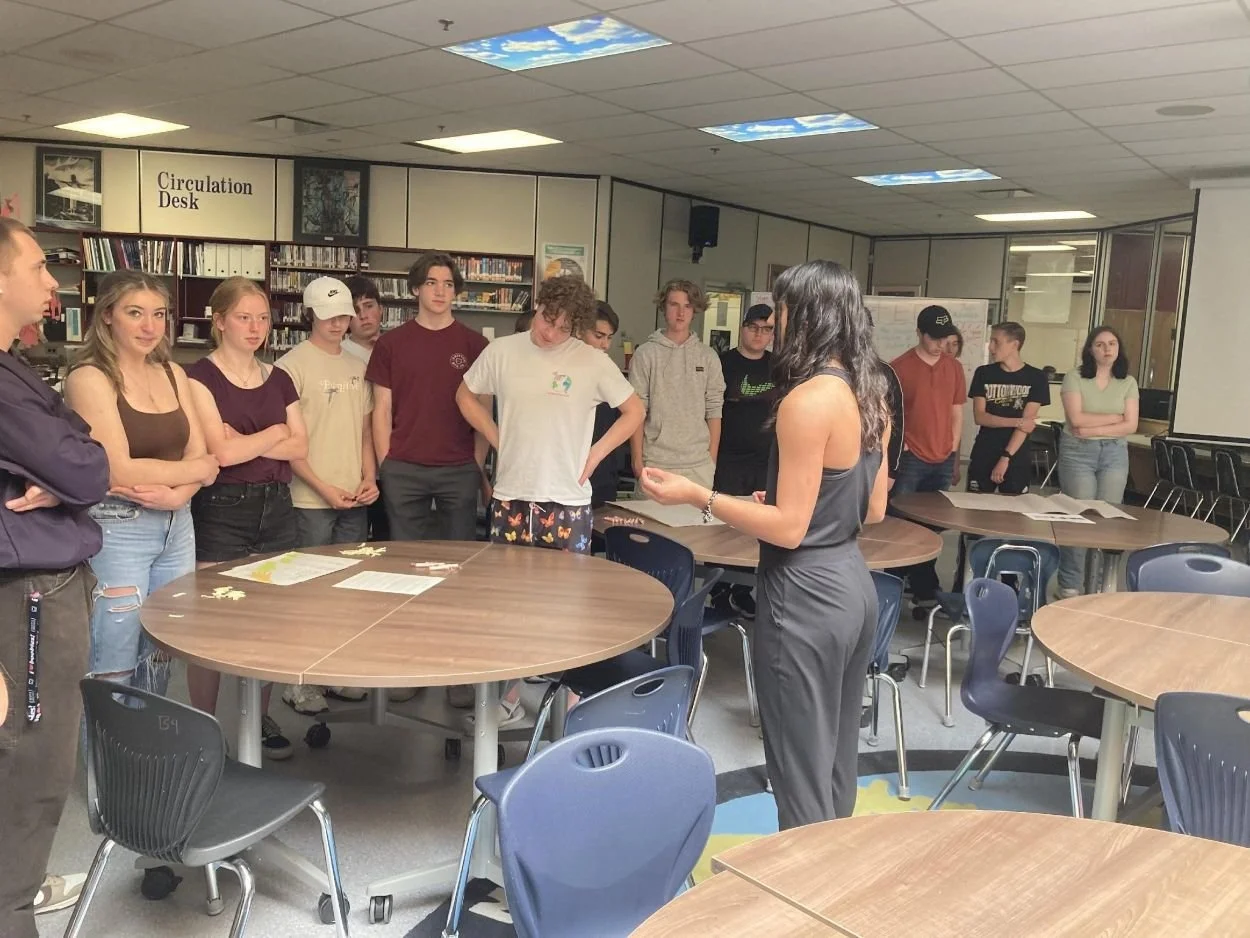
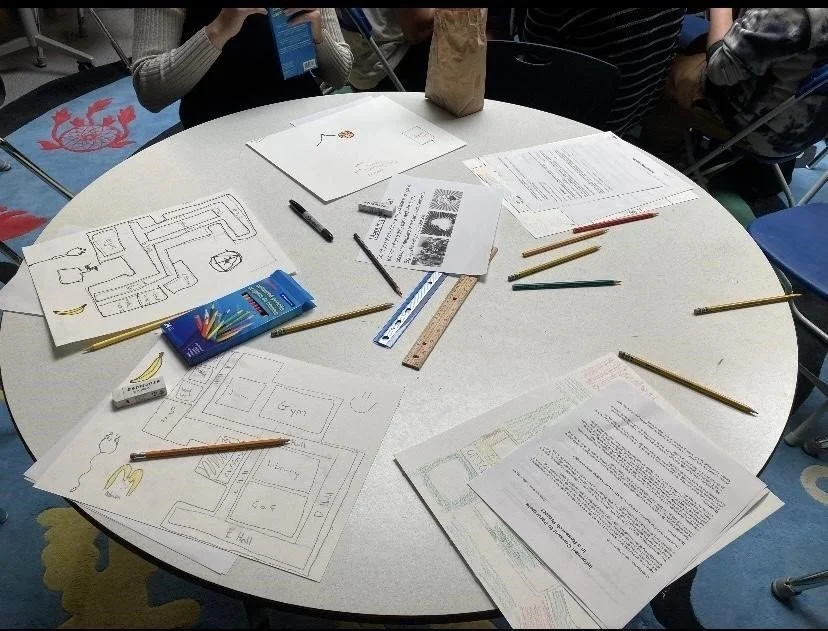
In the last year I have been doing volunteer work with Dr. Garrett-Petts, who is the Interim Vice-President of Research at Thompson Rivers University and my faculty mentor for my capstone project. Between September and June, 2022, I participated in several cultural mapping workshops and sessions at Thompson Rivers University so that I could a research project on EDI at Sa-Hali Secondary. I have also had lots of support within Sa-Hali for this project, and from TRU, including Kate Fagervik (a Learning Strategist for student research and public engagement). I did this research using cultural mapping methods, which provide an integrated picture of the cultural character, significance, and workings of a place to help communities [in this case, the community of Sa-Hali Secondary] recognise, celebrate, and support cultural diversity for economic, social and regional development (Nancy Duxbury, PhD). Participants were asked to draw a map, a visual representation, of their EDI experiences at Sa-Hali. A selection of the participants were interviewed, using the maps as a guide: they were asked to “take me on a tour of your map.”
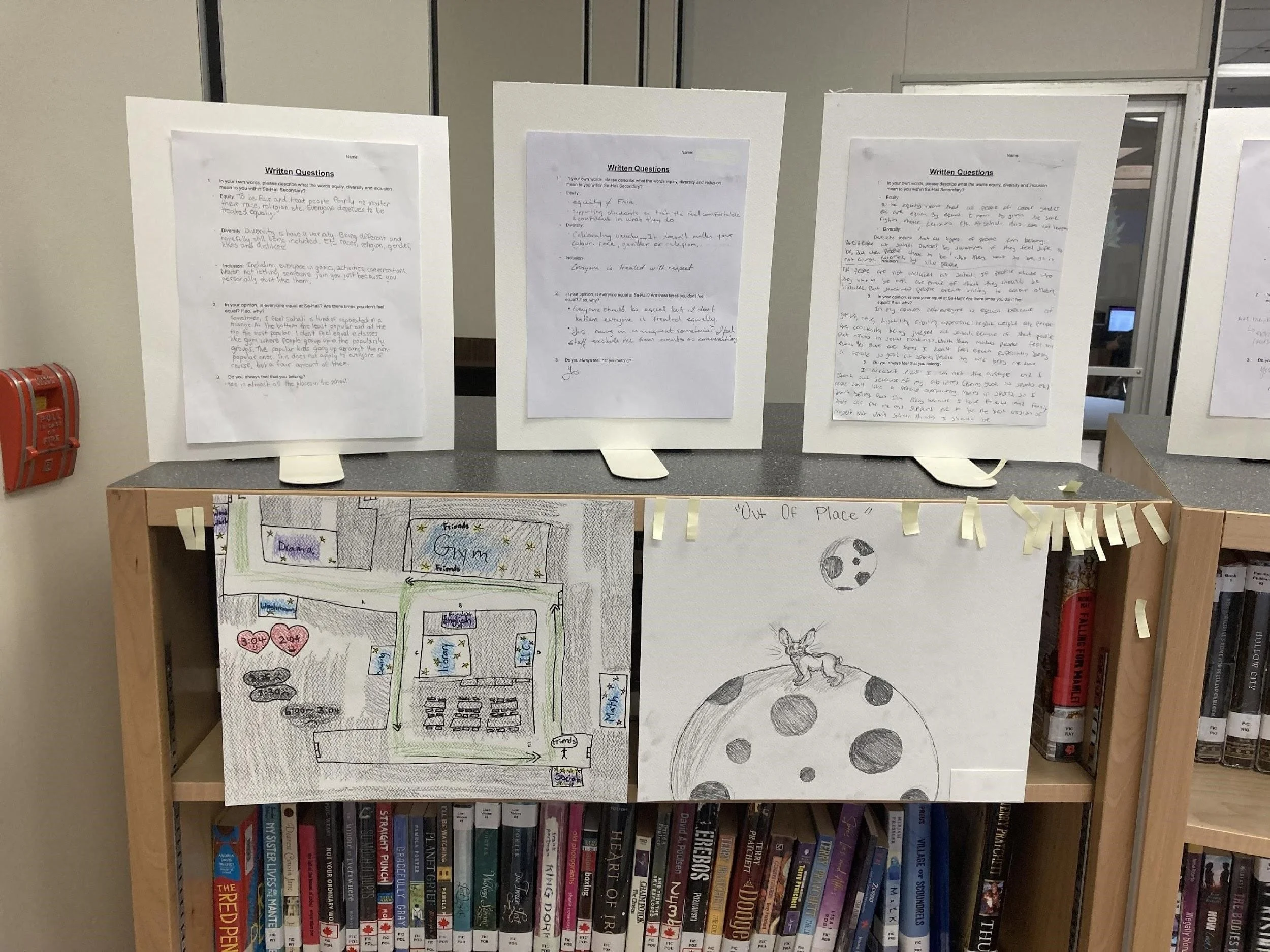
With permission from the school administration and support from school teachers, I was able to gather over 140 cultural maps, each sharing personal experiences of EDI at the school. There were two parts to the mapping session, which included the written question, where I asked participants to express their thoughts and perspectives through words. The second part included the mapping question, where students and staff expressed their answers through a visual representation. The four written questions were:
In your own words, please describe what the words equity, diversity, and inclusion mean to you within Sa-Hali Secondary.
In your opinion, is everyone equal at Sa-Hali?
Are there times you don’t feel equal?
If so, why, and do you always feel that you belong?”
The mapping question was: Could you please draw a map of where you go in the school daily and where you encounter negative or positive experiences of EDI?
After I collected all the maps, I found that through the analysis, there was a mix of both positive and negative things about Sa-Hali. Cultural mapping gives everyone a chance to express how they feel and share their experiences within the Sa-Hali community. Before making the maps, participants were given an overview of the project and asked for their informed consent. The staff and students who participated had volunteered, and they knew that they could withdraw from the project at any point.
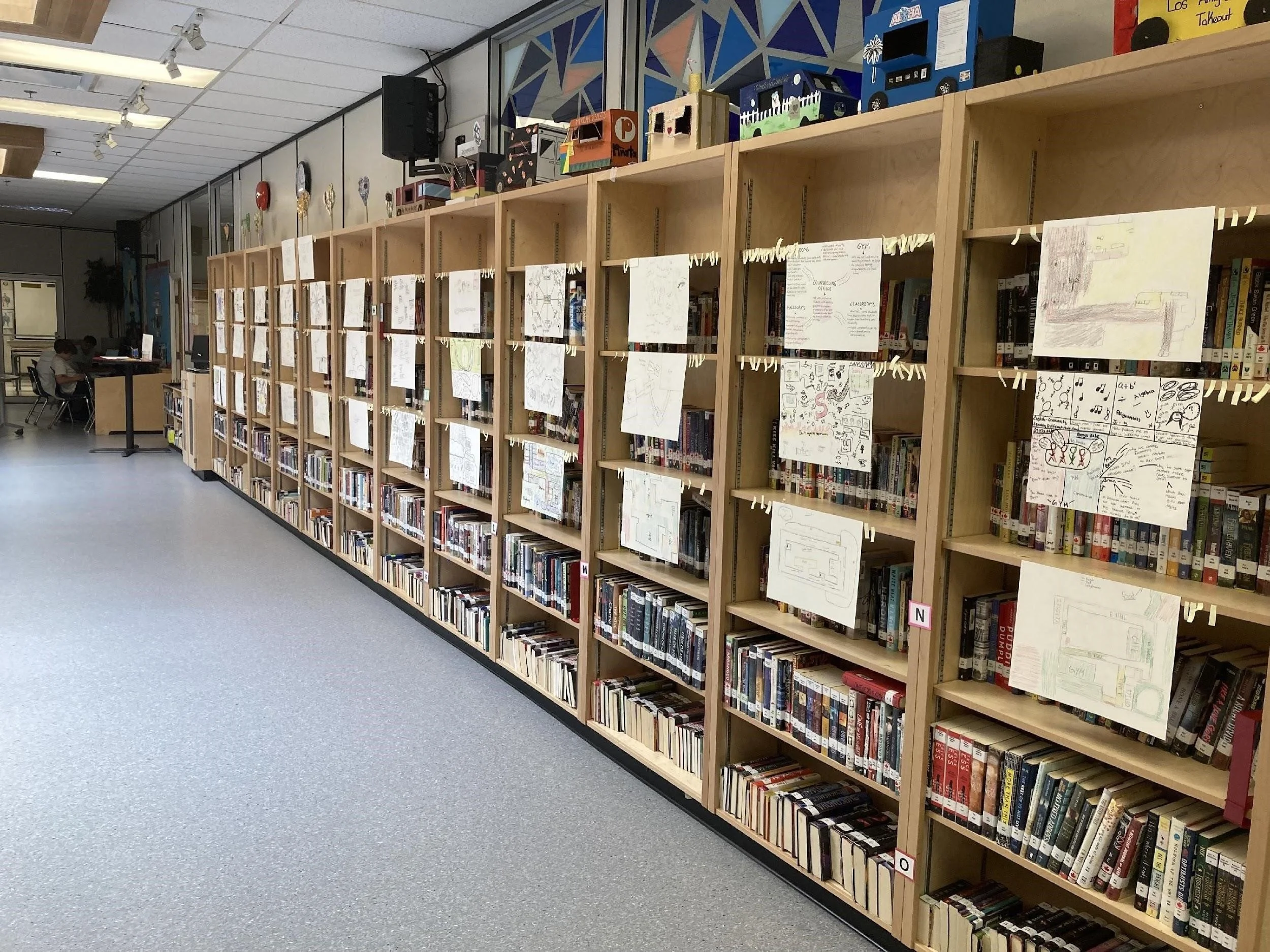
After I did all the mapping sessions (teachers, administration, students, members from the GSA (Gender Sexuality Alliance) club, Indigenous students and the Special Ed students) the next step was the interviews. Due to the number of people that participated it wasn’t feasible to interview all the participants within the amount of time I had. I interviewed six staff members and four students, but all the maps were included in the study. Analysis of each map takes approximately three hours, where I group the key features of each map, identify patterns (repeated elements within the maps and between maps), and then consider the patterns in the context of the interviews. The patterns revealed by the maps were key spaces at the school, including the gym, washrooms, the office, the staff room, and the library, which received both positive and negative responses. Lots of the maps showed a lack of connection and conflicting feelings, including personal frustration or isolation. The maps were looked at in terms of the paths represented (allowing for an assessment of range and ease of movement between spaces), districts identified (allowing for an assessment of where participants feel comfortable or uncomfortable gathering), nodes indicated (allowing for an assessment of where interests or activities converge), edges drawn (allowing for an assessment of the barriers to equitable inclusion and respect for diversity), and the landmarks included (allowing for an assessment of how participants orientate themselves in relation to physical or social places of inclusion, validation, and community consensus).
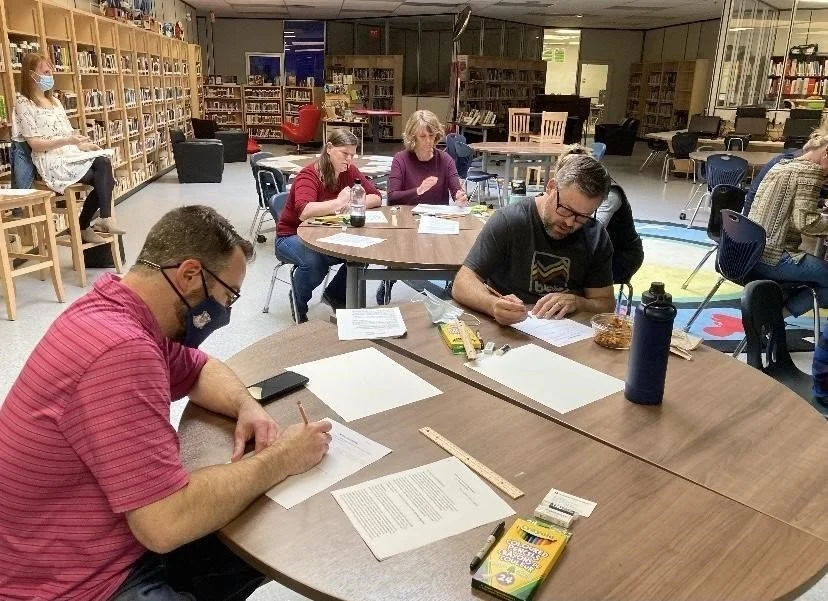
There were not many pathways connecting places and spaces. The edges dividing the school from the larger community showed barriers to EDI. One teacher’s map placed “equity, diversity, and inclusion” in a competing frame of “victimisation, blame, and entitlement.” Districts, where like-minded groups would gather, were identified as both positive and negative spaces. Districts can help decrease the number of barriers within the school. Nodes, where interests converged, and participants felt safe or encouraged, were identified by individual teachers and, especially, the library. Few physical places or landmark experiences were identified. Landmarks are crucial for building a sense of community. Examples of landmarks are things that Sa-Hali is proud of and important things we celebrate. This is integrated with what Sa-Hali stands for and what we value. Overall, people felt isolated, unsupported and disturbed. A small number of the maps presented an ideal representation, for tolerance and respect for diversity, as well as symbols of hope and statements of confidence that the promise of EDI could improve or was improving. Implementing the key five elements (pathways, edges, districts, nodes and landmarks) creates a stronger structure for EDI to flourish.
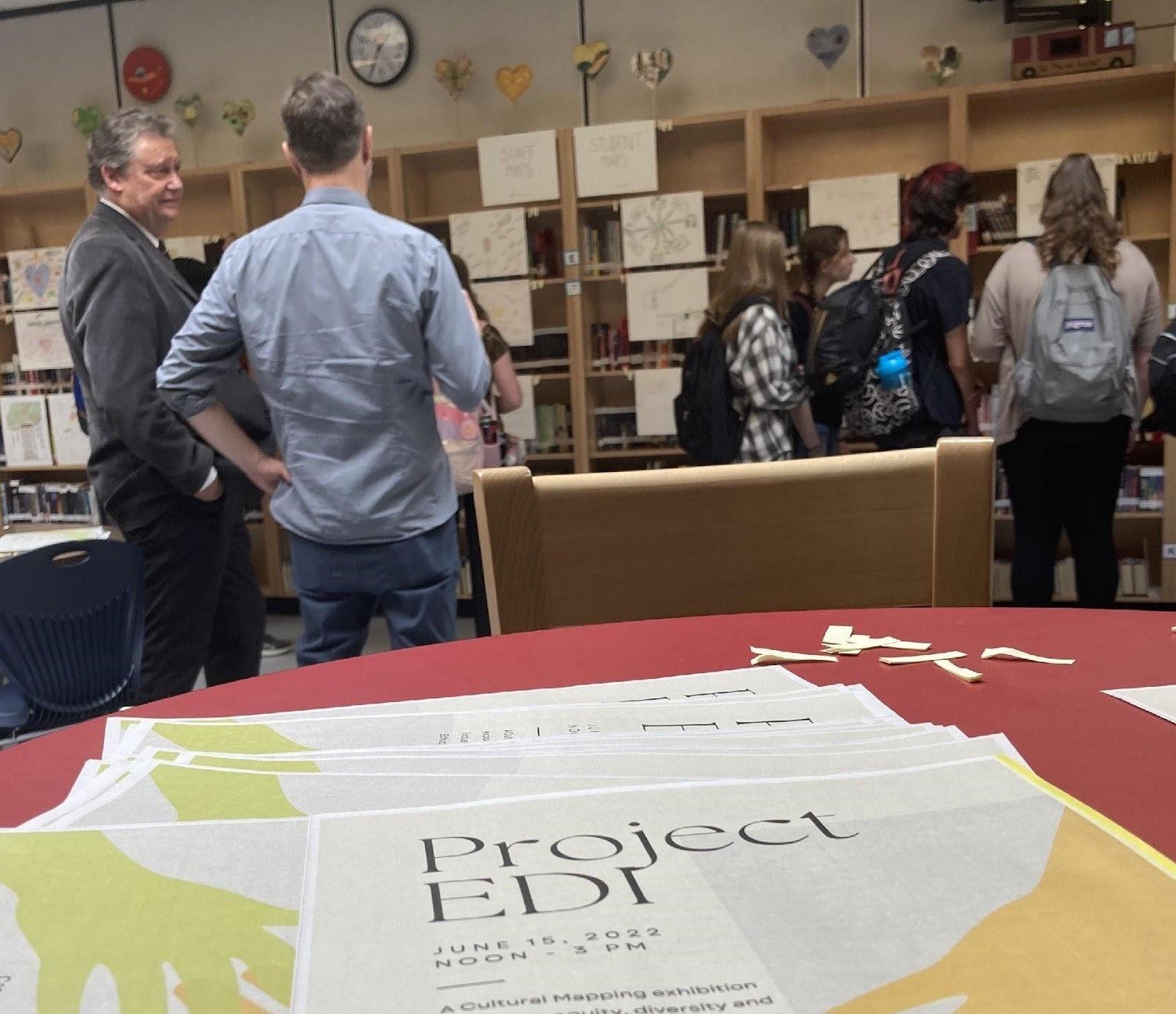
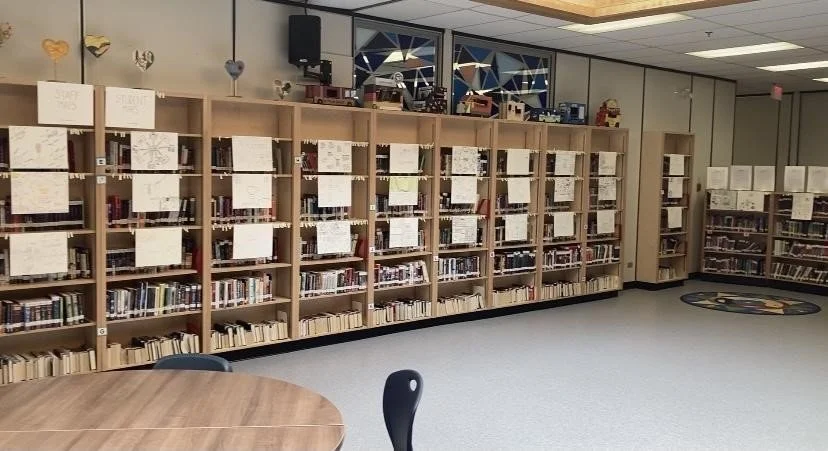
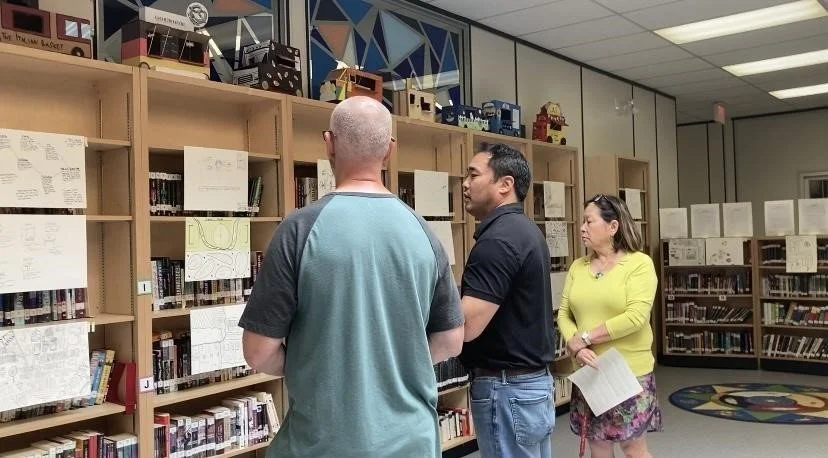
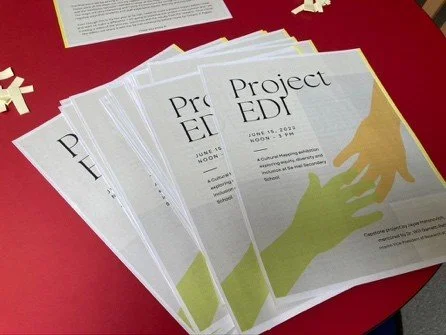
The next component of my project was the exhibition, because I wanted to show all the maps and the research process used. The maps are very interesting, and I think it is important for Sa-Hali to see the positive and the negative ways that students and staff experience equity, diversity and inclusion at the school. Even though this is my last year at Sa-Hali, I want to make a positive impact before I leave. I want to make a difference. I am going to continue this project in the summer, and I am creating a video of the process, with the aim of providing even more detailed outcomes and results from the research. Once I finish the video, I will share it with the Sa-Hali community before I leave for Ontario in August. This final report was written with the guidance of Dr Garrett-Petts. Images included were provided by Kate Fagervik.
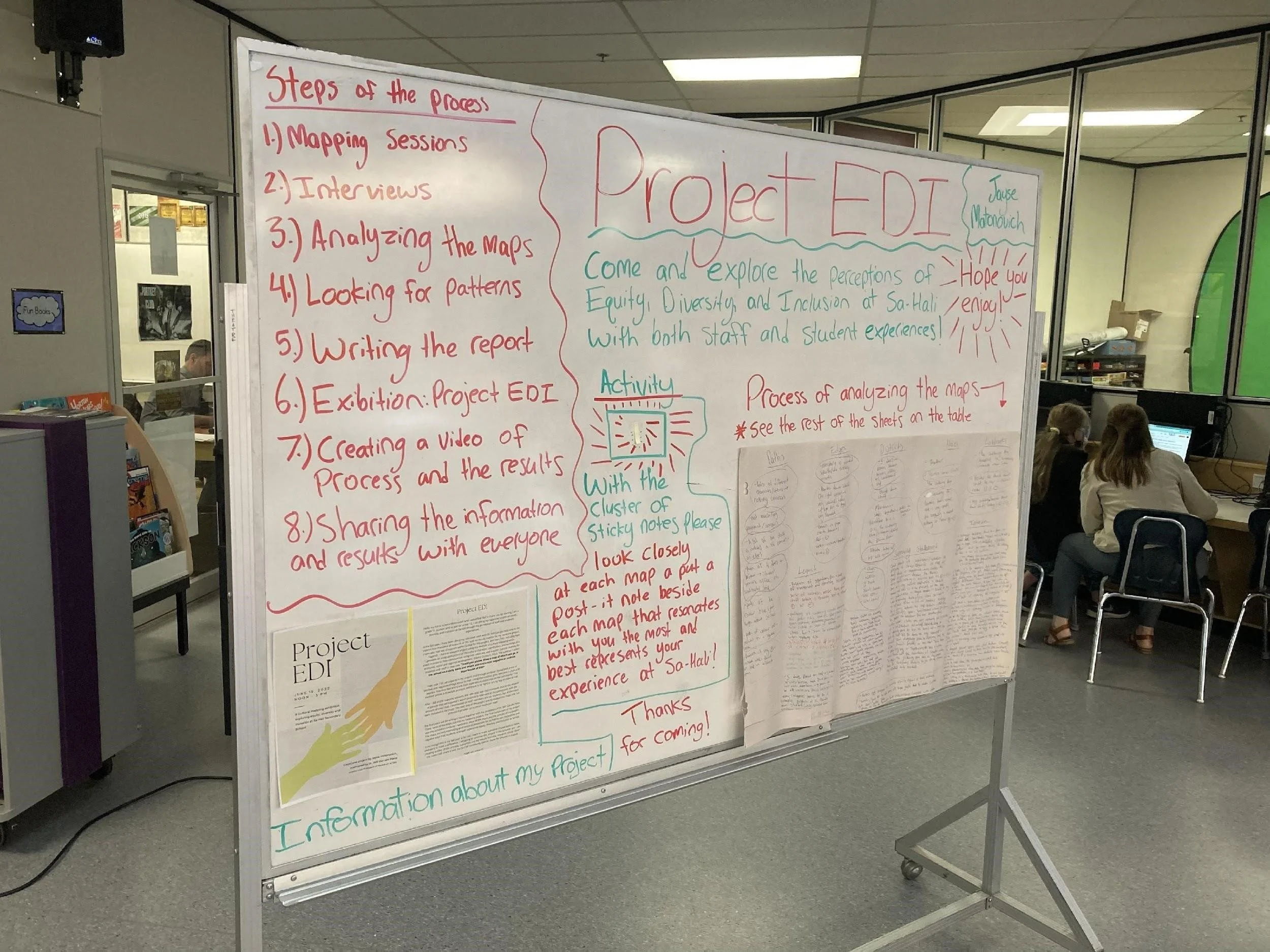
Summary of the Process and the Report Findings
During the last year, I engaged in a series of cultural mapping workshops and mentored tutorials at Thompson Rivers University to conduct EDI research at Sa-Hali Secondary. The research discovered equity, diversity and inclusion through the perception of staff and students through their personal experiences. Cultural mapping might help us look at issues within the school, so we can build up from here to create more positive experiences of EDI in the Sa-Hali community. All the maps were gathered and examined to assess key patterns of response. Ten of the maps (4 student maps and 6 teacher maps) were analysed in detail, with interviews conducted and transcribed.
To ensure that all voices of the participants were represented, and with the assistance of Kate Fagervik and TRU’s undergraduate research ambassadors, I curated an exhibition of all the maps in the school library. The exhibition included the maps and all my working notes, making the full content and research process available to anyone interested. Identifying elements (the names of the participants and references to individuals) were removed from maps displayed in the exhibition: the intent here was to keep the focus on the patterns of response rather than on individuals.
The Staff Maps
The initial patterns revealed by the staff maps highlighted key spaces in the school—the gym, washrooms, the office, the staff room, and the library—where both positive and negative responses were recorded. Many of the maps displayed a lack of continuity and contradictory feelings, including a sense of personal frustration or isolation. Pathways connecting places and spaces were few in number. Edges dividing the school from the larger community and indicating barriers to EDI were prominent. One teacher’s map placed “equity, diversity, and inclusion” in a competing frame of “victimisation, blame, and entitlement.” Districts, where like-minded groups would gather, were identified as both positive and negative spaces. Nodes, where interests converge, and participants feel safe or encouraged, were identified in terms of individual teachers and, especially, the library. Few physical places or landmark experiences were identified. The school’s diversity was referenced as an attribute, as a source of pride. Overall, individuals felt isolated, unsupported, and disturbed. A small number of the staff maps presented idealistic representations, emphasising assumptions of a loving and harmonious community. These maps represent aspirations for tolerance and respect for diversity, and even some of the more negative staff maps included symbols of hope and statements of confidence that the promise of EDI could improve or was improving.
Student Maps
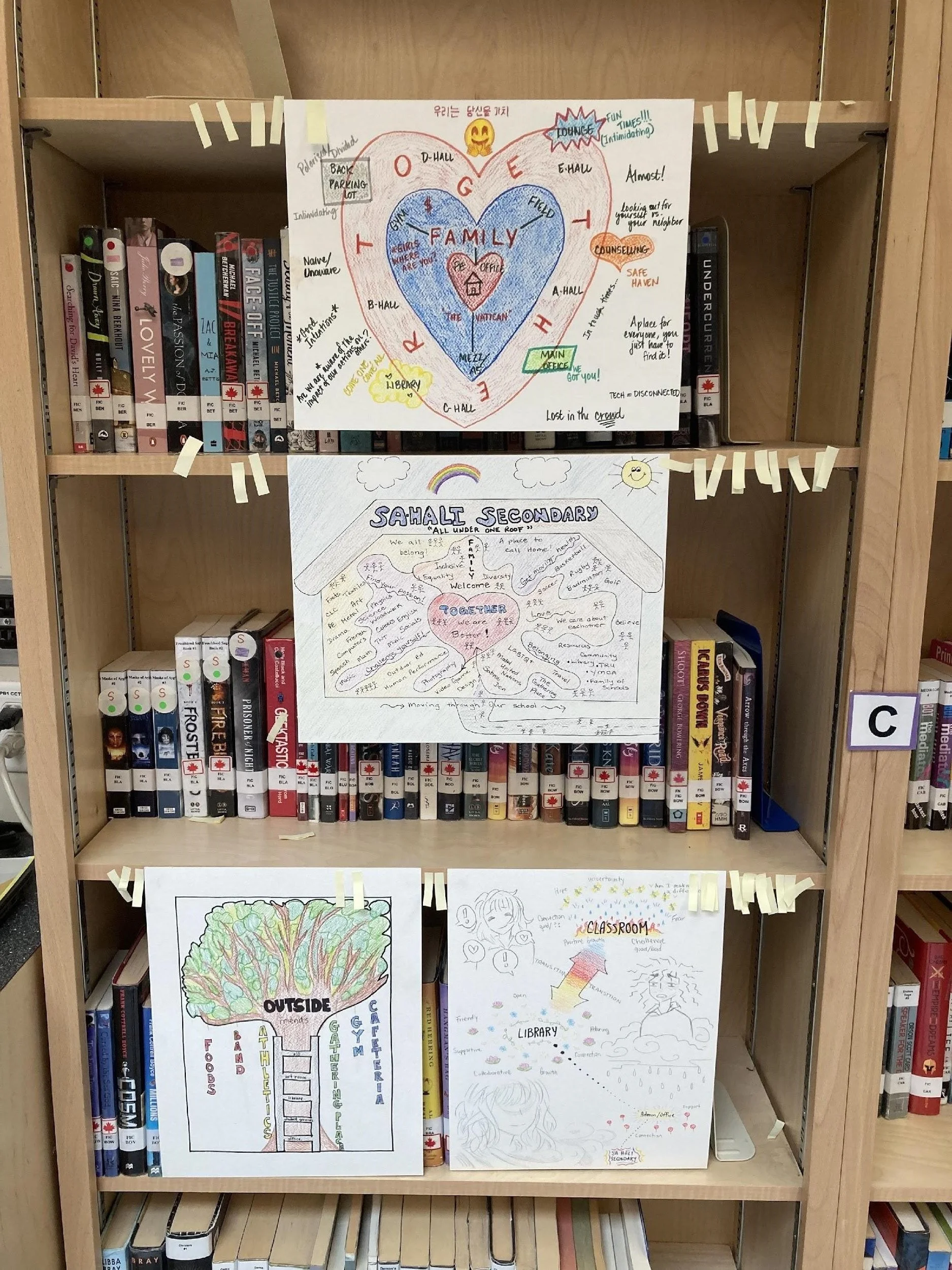
The student maps also revealed an absence of the clear pathways we might expect to see in a fully equitable and inclusive community. Instead, the elements of the maps were very boxed off, with clear edges suggesting a strong sense of limited movement and even isolation. Hallways are associated with negative experiences, where students express, receive, or overhear racist comments and offensive behaviours. “Little-to-no consequences” for such behaviours are noted, and so, according to one student, the cycle continues, with students in grades 8 and 9 learning from the older students. Sexist and racist language tends to be used indiscriminately, not directed at individuals but out of habit. The younger students interpret this as cool.
The Office is seen as scary and uninviting, and the washrooms are described as uncomfortable, with the D Hall washroom described as a danger zone. The vape pit and the cafeteria are depicted as generally negative or uninviting. Key districts and nodes are highlighted, in particular the gym, which in one map was itself divided into “the girls side” and “the boys side.” The gym is a place to “push yourself,” to be “competitive,” and to have fun. Students note that engaging in sports makes them feel safe and comfortable. But the gym is also seen as a place where gender bias is active, stereotyping is prevalent, and girls wonder whether they should stop trying to perform and compete. Another key node identified is the Counselling Office, shown in one map as the central node for the school, with pathways leading in and out. Stigma is associated with this node. In one map, only those students with lower grades are seen as seeking help. On the other hand, individual teachers are identified as safe and inclusive nodes where students turn to for help, advice, and a sense of belonging. The districts are further represented in terms of the courses taught, with English and Music seen as positive spaces for personal expression, creativity and tolerance of cultural viewpoints. With math as a space that pushes you to think in different ways. Social Studies is depicted as less relevant and inclusive. Individual classrooms, teachers, and the library are seen as the key contributors to EDI, providing Sa-Hali with “great places with positive energy” and encouraging a love of learning. The rugby field is also singled out as a positive space for fun and exercise. Like the staff maps, there are a few true physical or social landmarks depicted. The gym, the hallways, and some of the washrooms become forms of “anti-landmarks,” somewhere that is high profile but in important ways felt to be inequitable, demeaning, or risky.
Conclusions and Recommendations
The mapping suggests intense interest at the school in issues of equity, diversity, and inclusion. The maps highlight places where individuals feel safe or unsafe, included or not included. These places tend to be disconnected from one another, and, as a result, individuals view their experiences at the school as segmented and potentially isolating. This is true for teachers and students alike. The one exception is the school’s library, which seems to offer a model of equitable inclusion and an embracing of diversity.
While it is difficult to derive strong recommendations from a pilot project and analysis of only 10 maps, it is hoped that the exhibition and preliminary analysis will be a catalyst for further discussion and action. I feel the maps show the importance of ensuring more intentional and available EDI pathways, where students and staff feel comfortable in and moving between all spaces and places in the school. The success of the library in establishing a relatively inclusive space may provide a model for other classrooms, services, and facilities. Implementing the key five elements (pathways, edges, districts, nodes and landmarks) creates a stronger structure for EDI to flourish. Also important are the shared patterns emerging from both the staff maps and the student maps. While the staff maps tended to place the school in relation to broader issues and influences, and in relation to contexts outside the school, they shared a sense of frustration, disconnectedness, and isolation from the promise of an EDI-informed community. What also comes through in both the student and staff maps is a willingness to engage with the issues raised, a sense that equity and inclusion are shared goals, and that the mapping process itself can become a means of making visible the challenges and virtues of equity, diversity, and inclusion at Sa-Hali. As one teacher said during their interview, “Sa-Hali is ready to rip off the band-aid” and address the problems head-on. The students’ interviews expressed a similar sense that they, too, were ready to address the issues, especially in each of their classrooms. The important point is that the discussion of EDI needs to be distributed among all classes and well-integrated into everyday discussions.
In terms of EDI, pathways seem to be a challenge in terms of providing and ensuring free passage and mobility for all students and staff to feel comfortable and safe. We need to find a way of unifying paths and connect various areas of the school. Some paths can reveal a sense of togetherness and connection, but they can also reveal a significant sense of being isolated and disconnected within the school. Providing mobility for all students and staff should be a goal for the administration to ensure every space in the school is safe for everyone to manoeuvre in. This includes creating a safe environment for the Special Ed students to comfortably move around through the school; this also includes the ability of exchange students to freely move within the school, instead of always being closed off within the corners in the school, such as a space in the cafeteria, and a self-selecting classroom for eating and socialising. The library, for example, offers a functional space to everyone; there is no apparent stigma attached to the library, unlike, say, the counselling office (where you need help or assistance). Replicating the principles informing the library, extending them to other areas in the school would help. There would seem to be an opportunity, therefore, to make visible the shared commitment to and appreciation of diversity. Sa-Hali needs to embody its values in landmarks that both reflect and encourage EDI throughout the school. These landmarks could be physical or verbal in nature, but they should be designed to build censuses and build a sense of community. The number of districts and edges that separate the different parts of the school similarly needs attention. Through scheduling the arrangement of activities and mapping possible routes through the school, it seems possible to create more permeable boundaries. Anything that can be done to minimise the segregation of activities would be helpful.
A pattern within the bathroom is found with many students, they expressed a discomfort within the bathrooms at Sa-Hali, they felt it was an unsafe and uncomfortable space, as many people vape, sit and socialise, create Tik Toks and vandalise. Many students also felt uncomfortable going into the girls’ and boys’ bathrooms as they don’t identify as female or male. A recommendation would be creating more gender neutral bathrooms, like the ones by the office, to ensure those students who don’t identify as male or female have a safe place to go to the washroom
In addition, a common pattern found within student maps was the counselling office. Many students do not feel safe or comfortable going to the counselling office as they believe there is a stigma associated with it. Many of the students expressed the counselling office as a place where you go to get help, need assistance, or are associated with students having lower grades and not doing well in school. A recommendation would be to help promote the counselling office as a safe and positive area, and not associate it with students who need help, because students see this message as giving a negative impression. A suggestion for the counselling office would be to change the system for how you distribute the appointments. Instead of having bright green paper slips delivered to the students by their teacher, find an easier way for students to seek guidance or assistance through an online format, such as Google Forms or another online platform. The green slips are extremely noticeable, and everyone in the whole class can see if you have a counselling appointment. I think changing the system in how you set up the appointments will create a safer and more positive environment for students to get assistance. Furthermore, there will be a smaller chance of students feeling embarrassed or uncomfortable if we move to an online format.
According to both student and staff maps, the gym was a common district that was brought up in several maps and represented in a negative way. The gym is seen as an unsafe place for many students and staff; it creates a sense of isolation, especially toward the female population. Women in sport have faced many issues since sport began, but if we can adjust to some things, we can make a difference within the gym. Many people have expressed the typical stereotype that “boys are better than girls” still exists within the gym, and many people also expressed how the “jock culture” still exists within the gym. This shows that the unathletic people and the girls feel a sense of unacceptance.
Recommendations that can improve these issues are looking at gym class through another approach. Instead of having a gym class that focuses on the competitive nature of a mix of different people at all different levels, we should look at it through the lens of a lifelong commitment to physical activity and health. This includes looking at life through all different perspectives, like proper eating habits, nutrition, mental health, the importance of sleep and understanding sports culture and how you fit into it, because you can be an active participant, a spectator, a mascot or even a sports official. There are a variety of ways to get involved in the sports culture. Even having a basic understanding of the rules and regulations of the top sports that Canadians engage in can have a large impact. This can be very beneficial for everyone as we are all active participants in society. An example of this could be watching a game of hockey, soccer, football, basketball or any sport for a class and learning the rules to get a basic understanding. Having a basic understanding of the rules can help enhance a better experience in gym class. Having a continuous opportunity to learn a variety of different types of physical activities will help all students find something they enjoy, and this should be the goal: to help students find something they enjoy where they can feel included and a sense of belonging. Gym class should not be about being first or winning; it should be about getting everyone involved, plus finding something that you enjoy that gets you moving and active. Your grade should be marked on your involvement, work ethic, participation, effort, and willingness to try something new, plus set up and clean up. There should not be a separate set of requirements or expectations that girls, boys or students who identify as neither must meet; your mark should strictly be based on an improvement scale throughout the semester and the items listed above. Sometimes switching things up in gym class can be a positive thing, as everyone will have a chance to find something they enjoy. This includes incorporating yoga, meditation, different dances or even in-class work, such as learning about the important aspects that tie into physical activity and health. This can include the importance of injury prevention, hydration, nutrition and sleep or even watching sports games to understand the sports culture in society. The gym is a great area to create a positive landmark, as it can build school spirit and a strong sense of community, but getting everyone involved is a crucial part to establish a feeling of belonging.
Toward these ends, I would recommend the establishment of an EDI advisory group run by students, with support from teachers and staff. The advisory group would ensure a continuation of the classroom dialogue into the everyday activities of the school, including sports events, cultural events and gatherings of all sorts. A key element of the group’s terms of reference would be ensuring that the school’s policies and practices reflect an informed and shared commitment to EDI, with the aim of transitioning problem areas of the school and making them more EDI-friendly.
Two Critical Reflections
A Cultural Mapping of Equity, Diversity, and Inclusion in a Canadian School: One Student’s Research Journey (Continued)
Jayse Heer-Matonovich, W.F. Garrett-Petts, and Jonathan Brady[27]
Project EDI began as a school assignment, as an exploration of how students, teachers, staff, and administrators experience equity, diversity and inclusion as everyday occurrences in their school, Sa-Hali Secondary School in Kamloops, British Columbia. Before they graduate, high school students in B.C. are asked to complete a mandatory Capstone Project that emphasises critical self-reflection on experiences within school and out of school, engagement in a deep learning process, and a sharing of the learning journey and results through public presentation (BC Ministry of Education, 2019, p. 15)[28]
For her project, and as detailed in her school report, Jayse sought out and attended a series of cultural mapping research workshops offered by Thompson Rivers University, and then began her learning journey with an understanding that barriers to equity, diversity, and inclusion are systemic, and that institutions can only truly be changed when those issues are owned by those involved. Her project aimed to give voice, especially to those too often left out of the official conversation: the students. Jayse identified patterns of response in the maps, paying particular attention to how the participants moved through the school, and noting the places where the participants indicated feeling either most comfortable or most uncomfortable. She also engaged in a form of gap analysis, comparing a limited number of student maps with teacher maps and the accompanying interviews, considering the differing perspectives represented.
Once enrolled in university, Jayse continued to work on the project, this time within a supervised research program: supported by her faculty mentor, she secured Research Ethics Board approval, revisited the original data, collected new data, drew new insights through an additional NVivo-style analysis, and inquired further about the project’s impacts on school culture and policy.
Significantly, instead of treating student-generated data as the raw material for analysis by others, Jayse continued her role as principal investigator, analysing the results, drawing further conclusions, and leading the knowledge mobilisation process. With support from the school principal, she screened a self-produced video documentary on the project with the school staff and provided data for teacher workshops. This kind of shift in epistemic authority, we came to see, was both significant and challenging, echoing, perhaps, what Wood and Lemley recognised as the transformational power of students mapping for change. Jayse’s project involved working within and with the school to effect that change. Thus, we found ourselves at the intersection of participatory action research, cultural mapping scholarship, and critical pedagogy, and working with, we believe, a replicable model for how student voice can be converted from an object of educational concern into an instrument of educational transformation (Heer-Matonovich, et al, 2025).
Following the lead of Kevin Lynch’s (1960)[29] work on categorising and interpreting mental maps, our analysis of all the maps collected located personal experience in five geospatial elements of the school: its pathways, edges, districts, nodes, and landmarks. Lynch was an early proponent of personal mapping as a method to understand how city-dwellers move through and conceptualise their urban environments. As in Jayse’s school project, we adapted the mental mapping and journey mapping analysis techniques first introduced in his book, The Image of the City: Lynch found that people orient themselves in urban settings by means of mental maps. In his discussion of these maps, he introduced the notion of urban legibility (also called imageability and visibility), arguing that the cityscape can be read. People moving through the city engage in wayfinding, recognising, and organising urban elements into a coherent mental pattern. Lynch proposed that, in the process of reading the city, we develop mental maps consisting of five distinctive features:
Paths: routes along which people move throughout the city;
Edges: boundaries and breaks in continuity;
Districts: areas characterised by common characteristics or purposes;
Nodes: strategic focus points for orientation, like squares and junctions;
Landmarks: external points of orientation, usually an easily identifiable physical object in the urban landscape.
Once formed, legible mental maps give people an important sense of belonging, a sense of place, and a ready if largely intuitive, guide to finding their way around the city. This sense of wayfinding, belonging and sense of place, we argue, is similarly negotiated by those studying and working in schools, where experiences of equity, diversity, and inclusion may be documented and located in key places inside and outside the school. In Project EDI, for example, participants noted a lack of connection to some areas of the school, conflicting feelings, and multiple barriers to inclusion. Some maps reflected isolated and unsupported sentiments, while others presented hopeful representations. Cultural mapping encourages a place-based and inclusive planning approach. The following observations identify locations in the school that work for or against a positive EDI teaching and learning environment. The locations are those that show up repeatedly in the cultural maps, and are considered in terms of Lynch’s five features, attributes that we’ve modified as an interpretive schema for the school maps:
Paths/Mobility: personal comfort in moving throughout the school
Edge Areas: barriers to an EDI-healthy environment
Districts: themed areas where people gather
Nodes: areas or people that facilitate or inspire a convergence of interests and activities
Landmarks: areas or physical symbols or words that orientate people in relation to physical or social places of inclusion, validation, and community consensus.
Attributes drawn from the maps and relevant to each school location were revisited and refined as Jayse continued her study at university. The findings, summarised below, both extend and validate many of the school report’s initial observations:
Hallways: Movement within the hallways seems problematic for many students and some teachers: the hallways, as experienced, seem to foster a culture that tolerates negative verbal exchanges (occasional personal, sexist, and racial slurs; homophobic comments). Experienced as a negative pathway space for many, with excessive pushing and shoving. The space can be physically intimidating for younger students and even teachers.
Cafeteria: Movement within this nodal space can be difficult for some; it is felt to be overly crowded by many, hot, uncomfortable and potentially alienating. The social and physical setting can restrict social interaction and feel isolating, especially for those who find themselves not included or part of a group.
Library: The school library is seen as a key node and district, an inviting working space encouraging easy movement free of judgment. Librarians are seen as guides by students, a safe space, a comfortable meeting and working space, an environment conducive for free inquiry and expression, and a non-judgmental space. The librarian is seen as an advocate of EDI, a key nodal figure embracing inclusion.
Gym: The school gymnasium is both a node and a district, and creates a sense of ambivalence for some students: a place that celebrates physical exercise, sports, competition and landmark achievements, but that can also be experienced as inequitable and unwelcoming to those with diverse abilities. Movement within this space seems more affected by gender and physical prowess than in other areas of the school. Those who are involved in sports tend to move easily in the gym, experiencing it as a positive and comfortable district. The gym is a place of celebration and school pride; most students see the gym as generally positive. Movement in this space can be difficult for some, especially those who may feel out of their element, concerned about their physical abilities, self-conscious or on display. Movement in this space can feel unsafe/uncomfortable, where some students feel a sense of isolation, embarrassment and judgement, “always feel like people are watching you when you are moving or trying to participate and try something new”. Younger students, some girls, and those who see themselves as unathletic may feel out of place, that they do not belong. The older students can be seen as intimidating or unwelcoming
Back Parking Lot: Movement in this nodal space can feel unsafe or risky, with people driving too fast or erratically. Unsafe driving practices may intimidate pedestrians walking in this area. Proximity to the vape pit, an outdoor space designated for student vaping, creates a sense of discomfort for many of the younger students and the students who do not vape. The vape pit provides a gathering place and welcoming node for some students.
Bathrooms: These nodal spaces tend to generate issues of personal safety and expressions of discomfort. Students and teachers alike identify these spaces as generally uncomfortable and potentially unsafe due to vaping, vandalism and use of cell phones (for making videos and TikToks). Some students use the bathrooms as spaces for meeting and socialising, creating a sense of discomfort for others who simply want to use the washroom facilities. Few of these spaces are designated as gender neutral bathrooms.
Counselling Office: This space is both a node and connected to the office district, and is recognised as offering an important, positive service; but the office’s highly visible location works against students’ experience of counselling as private or confidential. Counselling services are regarded as important, a place with positive intentions, a counsellor is seen as performing a key nodal role, and the location creates a sense of embarrassment for some. The counselling office is experienced as an unwelcoming place by others
School Office: The Office is a node for those visiting or passing through, and a district for those who work in the space. It provides the official face of the school, a place of power and authority. The office is seen as a highly welcoming environment by staff. The office is seen as representing the school principal, who sets the tone for the school, the principal is a key nodal figure, a leader for students and teachers alike. Some students perceive the office as a potentially negative place (somewhere they only go if they get in trouble)
Classrooms: These spaces are seen informally as nodes, but more generally as districts defined by the subject areas taught and the classroom culture created by individual teachers. They are generally coded as positive spaces, familiar and encouraging, positive areas to learn and express thoughts and opinions and safe spaces. Some students, however, find them to be a negative area, feeling judged when expressing their thoughts, but they are regarded as EDI-friendly spaces, for the most part
Staff Room: Teachers express a sense of ambivalence toward the staff room space as both a node and a district. Lunch or staff meetings can generate collaborative group discussion or can be experienced as isolating, inequitable and unwelcoming, not experienced as always EDI-friendly.
Landmarks: The maps were notable for the absence of landmarks, visual, verbal, and symbolic representations that speak to or reinforce school values. The graduation murals [created by each graduating class] on the school walls help create a public sense of school culture and belonging. The word “together” is featured prominently on multiple maps. The school sports mascot is represented prominently in multiple maps. Variations of pride flags are present in some maps.
Overall, to date, the project in its various iterations has spanned four years, demonstrating cultural mapping’s potency as a sustainable vehicle for validating student voices and empowering students as researchers. Moreover, Project EDI has produced credible and actionable findings, with the potential to provoke measurable change in institutional culture. Counselling services have changed, the school bathrooms have been made more hospitable, attention is being given to hallway etiquette, and the library is being explored as a possible model for other areas of the school.
The study is also unusually transparent about its tools, its process, and about a productive friction it generated among school staff, thus responding to Vadeboncoeur and Hanif-Shahban’s call for enhanced documentation of the conversations and impacts generated by the mapping. That productive friction merits close attention, in part because it is both the most uncomfortable part of the project’s history and perhaps its most instructive. It is an element of the research process we are still exploring.
When early findings were initially presented to the school’s teachers, a vocal minority (approximately 20% based on a post-mapping survey) wanted to discount the research, noting that a student-driven project, while commendable, might have limited academic validity. The objection is important to take seriously, not because it is true, but because it foregrounds the epistemic obstacle that projects embedded in school settings need to anticipate, confront and work through. Teachers predictably encourage and celebrate inclusion of student voices, especially within the structures they control. But Jayse’s research, given its very public support from the school principal, enjoyed enhanced institutional standing that, in the minds of some, may be seen as bypassing everyday teacher authority.
In this case, however, remarkably, and at the principal’s direction, Project EDI remained on the staff meeting agenda for 26 months, from May, 2023 through June, 2025, creating the conditions where initial resistance gradually gave way to productive reflection. The discomfort the project generated, which we first worried might reflect a deficiency in the methodology, became an indication of its effectiveness: cultural mapping brought to the surface experience and patterns, including patterns of response to the data gathered, that more comfortably entrenched research approaches and institutional processes possibly could not. The friction it provoked raised the stakes for those involved, encouraging ongoing reflection and discussion about the school’s aspirational values and its daily practice.
The principal has since said he believes the student-led research drove, and continues to drive, significant engagement in EDI awareness and positive changes in school practice. He has also indicated a willingness to replicate the study at a future date, using the initial mapping as a benchmark for improvement. These are results that few student capstone projects (and relatively few university research studies) can claim.
My Research Journey: A Visual Autoethnography
Jayse Heer-Matonovich
This visual autoethnography is offered as a complement to our academic essay and begins with a personal mapping of my research journey. In the spirit of my cultural mapping project, it aims to make visible my embodied experience of the pathways (taken and not taken), the edges and barriers encountered along the way, the nodal points where my personal and academic interests converged, and some landmark moments of discovery.
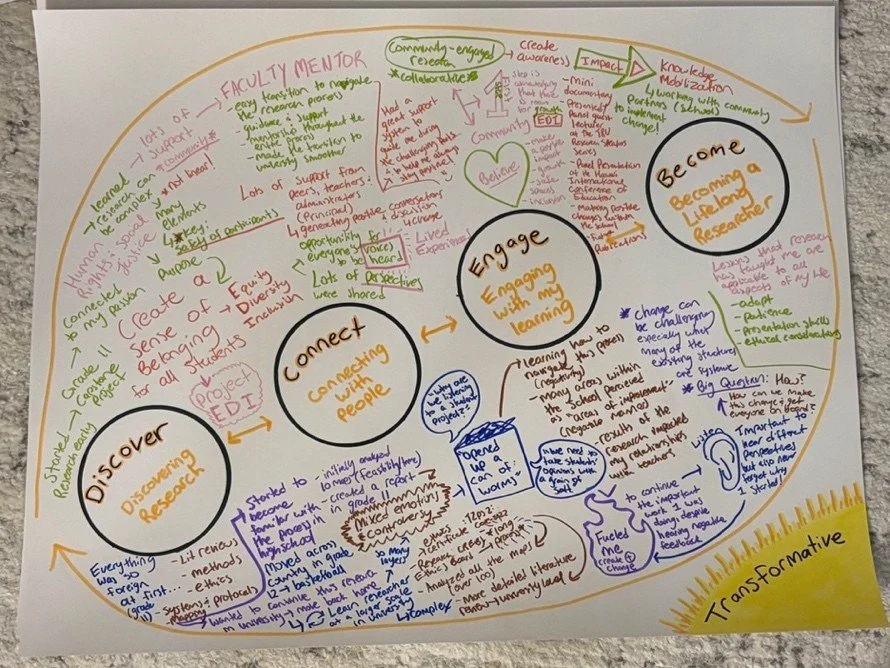
My Research Journey Map, April, 2026
This research project started as a “capstone project,” a mandatory course for high school graduation, but it developed into a meaningful scholarly journey that connected to my passion for human rights (creating spaces of belonging). Growing up as a racialised female, I have developed a strong passion for human rights and social justice. The project was a transformative experience that allowed me to learn significant life lessons and helped shape my identity as an emerging researcher while navigating external barriers throughout the process, including external power relations and social norms. In grade 11, the initial introduction to research was a bit overwhelming, as I had to understand all the research elements, including how to navigate the ethics process, form a research question, choose a methodology, and ensure that all materials and steps were organised. I was fortunate to have a faculty mentor and support from the university research office to guide me throughout this process. The more I learned about the different elements and how to conduct research in an ethical manner, the more I fell in love with that process.
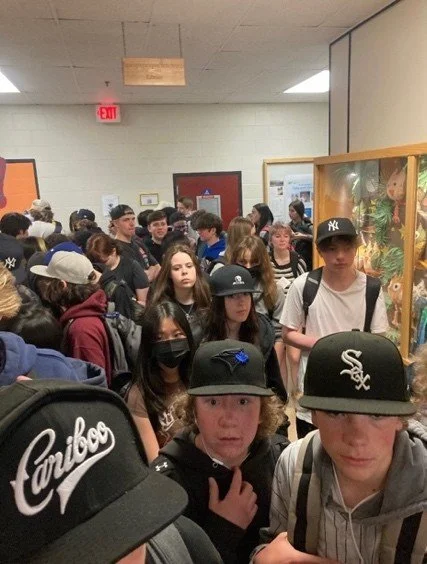
We used a method, cultural mapping, which was foreign to many students and teachers, and new to me. This was my first time doing research, and I wanted to make sure we had enough people involved in the project, which is why I brainstormed different strategies to engage and recruit a wide range of students. I spoke on the morning announcements, I visited classrooms, and I designed two types of posters for the school walls to engage students who had a passion for learning, and for those who were still searching for it, to ensure that all perspectives could be heard. I was excited to see that we had 80 participants sign up for the cultural mapping session, as our initial target was 20 participants. On the day of the cultural mapping session, we had over 150 students pushing through the narrow hallway, trying to get inside the library to participate in the mapping session. This situation generated mixed responses: I felt encouraged by the number of students wanting to participate in a process that amplified their voice; however, managing such a large volume of students attempting to move through the library presented logistical challenges. Everything flowed smoothly during the mapping session. With the help of the librarian, we were able to adapt and create more spaces for students to join. The capacity of the library was at its maximum.
The initial findings from the project were shared through a presentation and exhibition. I remember the sense of anticipation, for this was the first time that students and staff got to see the maps, the perspectives of their peers and colleagues. The reveal of the maps showed the school community that not everything is always positive, and certain areas were seen as more exclusive than inclusive. I had built many relationships with the teachers at my school, and when many of them saw the results of my project, the dynamic of our relationship changed. Some of my teachers treated me differently. They took the exhibition personally, likely because the areas associated with their spaces were represented by students in a negative manner. Some teachers and staff stopped talking to me or publicly questioned me about the accuracy of the research. There were several less-than-flattering comments about trusting and using a student’s project to create change. Some said that students' opinions should be taken “with a grain of salt,” for they cannot always be trusted. This brought home to me how power dynamics between students and teachers can influence whose knowledge is considered valuable and trustworthy.
As a result, I became concerned about my grades, and also about how some might treat my sister. My sister is two years younger than me, and I was worried about how this was going to impact her relationships with the teachers who knew me. Overall,in the main, I received positive encouragement from many administrators and teachers; I felt disappointed about how some reacted.
The video documentary began production in the spring of 2023, when I enrolled in university, a year after the capstone project began. Here we present an honest but more positive take on the research. The voices represented are genuinely reflective, but also reflect those willing to be captured on camera. I wanted to make a further impact by creating and sharing a video, and working with a student videographer (Luke Redgrove) made the project come to life dramatically.
This video allowed the participants to speak in the first person about the project in detail, and also allowed for a different, more accessible form of knowledge mobilisation.
Link to the video Project EDI 2025
The documentary was designed to allow a revisiting of the mapping process, and was shared with the teachers as part of a follow-up in-service led by the school principal. As a result, the school has committed to further in-service workshops, with the aim of addressing the EDI issues raised on an ongoing basis. The principal has expressed a desire to replicate the cultural mapping to measure any changes in the EDI experiences of students, staff, teachers, and administrators. The documentary also served as an extension of the project’s exhibition component, keeping the maps visible and honouring the voices of the participants.
When I look at my research journey map, to “take you on a tour of the map,” I want to begin with the overall shape. It is a closed ellipse: an encompassing, organic membrane containing the entire journey inside itself. By design, nothing falls outside the boundary except the single word at the bottom right: Transformative. That word isn’t inside the oval because it isn’t really a stage or a node—it is a retrospective characterisation of the whole. The shape of my map says: this journey isn’t all about going somewhere; it changes you from within a contained experience. The ellipse is relational: the four sequenced circles
Discover → Connect → Engage → Become sit inside the ellipse as phases within a larger whole; and, in truth, the arrows between them should be bidirectional (↔), for the phases talk back to each other.
On the left margin, before the first circle and before the formal research journey, I’ve placed several notes of personal significance: “Human Rights; Social Justice,” “Connected to my passion,” “Grade 11 → Capstone → research.” The research journey, for me, began with a prior moral commitment, a reason for caring, that predated my connection with the university and predated consideration of the mapping methodology. In my case, intention has a history.
Buried in the lower section of the Discover circle, I’ve included references to moving to a new city and basketball. These are biographical details which likely have little place in any academic article, but for me, they are relevant. They are part of why Sa-Hali’s EDI climate mattered to me personally, and still matters, for as I see it, my viewpoint was tied to my experience as a school athlete. My success in playing basketball enhanced my stature and probably played a role in gaining teacher and student support. Lives are not separate from scholarship.
The positioning of the challenge to my research (“Why are we listening to a student project?”) is remembered as a kind of wound and placed as part of the flow of my journey. Its placement matters. It appears after the Engage circle, for I did not encounter teacher resistance at the beginning. All those I spoke with were encouraging and enthusiastically supportive of my admittedly ambitious project. The expressions of institutional scepticism came later, after I had begun to find my footing as a researcher.
"Opened up a can of worms / Mixed emotions / Controversy" these notes cluster around the Engage circle, coinciding with the presentation of findings that were clearly uncomfortable for some members of the school community. In the academic introduction to the accompanying essay that we worked on together, we described this moment diplomatically as “productive friction.” In my map, I see I’ve rendered it differently, more personally, with more of the ambivalence felt: not triumphant, not catastrophic, but genuinely unsettling. To my mind, the map is more epistemically honest in a way that published academic accounts seldom are. In our case, my journey map preserves elements of my experience that the more formal article tries to explain and manage.
One of the most important notes on my map reads: “Change can be challenging, especially when many of the existing structures are systemic” I need to be honest about the incompleteness of this project. Near the bottom right, adjacent to the Become circle, I’ve written: “Big Question: How can we make this change & get everyone on board?” This question is not answered on the map. It remains open, and it is a question I carry with me.
The research is institutionally complete (report written, presentations made) but epistemically unfinished. I look at how Community-engaged research / collaborative node at the top connects to Impact → Knowledge Mobilisation → Working with community partners (school) → community change! The exclamation mark is important. It was and is my aspirational starting place and end goal. But that goal shifted from wanting, initially, to shed light on and solve EDI issues in the school to wondering about the implications of bringing systemic change to an institution that questioned my authority to investigate it. My journey’s climax, in other words, rests on the moment when research became personal, and thus even more consequential.
Project EDI propelled my learning experience as I got to practice sharing my research at my school, at the university, and even at an international conference. But more importantly, it has given me an insider’s view of how research works, or can work, to advance EDI and social justice. As I enter my fourth year of university, I consider myself an emerging scholar committed to making knowledge while navigating the systemic issues and politics endemic to existing power structures.
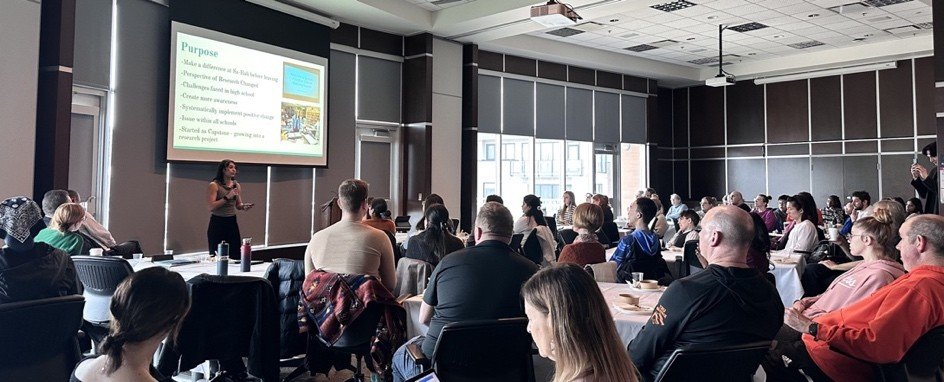
Project EDI: Cultural mapping of equity, diversity, and inclusion at a local secondary school.
Invited Panel Presentation, Faculty of Education and Social Work Lecture Series, Thompson Rivers University, February 8, 2024.
Personal Acknowledgement
Many individuals supported and helped shape my research into a positive experience. I would like to thank the following people: Dr Will Garrett-Petts, for his guidance and mentorship throughout this project. Principal Jonathan Brady, for believing in this project and its potential impact. Kate Fagervik, for her guidance and for liaising with the university research office. Luke Redgrove, for his video expertise on the mini documentary. The Sa-Hali Secondary community, especially those individuals who participated in the cultural mapping sessions, the interviews, and the video documentary, your support and encouragement provided a great commitment to EDI. Finally, the TRU community and research office for their support, especially to the TRU students who helped set up the school exhibition. Your commitment to EDI and support throughout this project is truly appreciated.
Acknowledgements
The authors gratefully acknowledge financial support from the Social Sciences and Humanities Research Council of Canada through their Insight Grant program, with additional support provided from Thompson Rivers University.
Endnotes
[2] Abrams, J., and Hall, P. (2006). Else/Where: Mapping new cartographies of networks and territories. Minneapolis, MN: University of Minnesota Design Institute.Thompson Rivers University.
[3] Bryan, J. (2011). Walking the line: Participatory mapping, indigenous rights, and neoliberalism. Geoforum 42: 40-50.
[4] Caquard, S. (2013). Cartography II: Collective cartographies in the social media era. Progress in Human Geography 38(1): 141-150
[5] Crawhall, N. (2007). The role of participatory cultural mapping in promoting intercultural dialogue: ‘We are not hyenas’. Concept paper prepared for UNESCO Division of Cultural Policies and Intercultural Dialogue.
[6] Gerlach, J. (2010). Vernacular mapping and the ethics of what comes next. Cartographica 45(3): 165-168.
[7] Gerlach, J. (2014). Lines, contours and legends: Coordinates for vernacular mapping. Progress in Human Geography 38(1): 22-39.
[8] Guldi, J. (2017). A history the participatory map. Public Culture 29(1): 79-112.
[9] Hunter, V. (2019). Vernacular mapping: Site dance and embodied urban cartographies. Choreographic Practices 10(1): 127-144.
[10] Kerski J. (2014). Mapping for understanding community, region, and the world: Using GIS in native education. In Code, D.G, and Sutton, I. (eds). Mapping native America: Cartographic interactions between Indigenous peoples, government, and academia, vol. 3. North Carleston, SC: CreateSpace Independent Publishing Platform.
[11] Kitchin R., and Doge, M. (2007). Rethinking maps. Progress in Human Geography 31(3): 331-344.
[12] Roth, R. (2009). The challenges of mapping complex indigenous spatiality: From abstract space to dwelling space. Cultural Geographies 16: 207-227.
[13] Wood, G., and Lemley, C. (2015). Mapping the cultural boundaries in schools and communities: Redefining spaces through organising. Democracy & Education, 23(1), Article 3: 1-5. https://doi.org/10.65214/2164-79921096
[14] Vadeboncoeur, J.A., and Hanif-Shahban, S.A. (2015). Cultural mapping as a social practice: A response to “Mapping the cultural boundaries in the schools and communities: Redefining spaces through organising.” Democracy & Education, 23(2), Article 9: 1-5. http://doi.org/10.65214/2164-7992.1223
[15] Jankens, A, Varty, N.G., Lindner, A.E., Jimenez, L., Lorenz, M., Begian-Lewis, K.M., Hart, C., Mixon, A., Shiekh, M. and Hakim, L. (2025). Structured discussions about linguistic diversity: Student voices and campus-based cultural mapping.” English Faculty Research Publications 34: 1-22. https://digitalcommons.wayne.edu/englishfrp/34
[16] Art of Belonging (2026). Collaborative mapping. [Website] https://artofbelonging.org/collaborative-mapping
[17] Burch, S. (2015). “Reading the city”: Cultural mapping as pedagogic inquiry. In Eds. Duxbury, N., Garrett-Petts, W.F., and MacLennan, D. (Eds.) Cultural mapping as cultural inquiry (pp. 193-216). New York: Routledge Books.
[18] Burke, A., and Boison, B. (2025). Cartographies of voice: Children’s multimodal literacies, agency, and identity in public pedagogy. Journal of Early Child Lit 25(4): 1073-93.
[19] Gordon, E., Elwood, S., and Mitchell, K. (2016). Critical spatial learning: Participatory mapping, spatial histories, and youth civic engagement. Children’s Geographies 14(5): 558-572. https://doi.org/10.1080/14733285.2015.1136736
[20] Heritage BC (2026). Cultural map classroom resources. [Website] https://heritagebc.ca/cultural-maps/teaching-resources/
[21] Jagger, S. (2016). “It’s more like what you think of land”: Bringing together community and education through mapping. LEARNing Landscapes, 10(10): 105-124.
[22] Lenny Learning. (2026). Mapping our belonging. [Website] https://www.lenny.com/lesson/mapping-our-belonging-545272
[23] PublicMAP (2026). Cultural mapping [teaching resource]. https://publicmap.org/en/teaching/cultural-mapping Retrieved February 25, 2026.
[24] Pyne, S., Castron, M., Parish, A., Farrell, P., and Johnson, S. (2022). Mapping for awareness of indigenous stories. ISPRS International Journal of Geo-Information, 11, 292. https://doi.org/10.3390/ijgi11050292
[25] University of Michigan. (2026). Mapping social identity timeline activity. [Website] https://sites.lsa.umich.edu/equitable-teaching/mapping-social-identity-timeline-activity/
[26] Yu, S., Han, H., and Ahn, H. (2026). Mapping children’s sense of belonging through multimodal composition in the classroom. Language, Culture and Curriculum, 39(1), 17–38. https://doi.org/10.1080/07908318.2025.2534382
[27] Heer-Matonovich, J., Jonathan Brady, and W.F. Garrett-Petts. (2024). Project EDI: Cultural mapping of equity, diversity, and inclusion at a local secondary school.” Invited Panel Presentation, Faculty of Education and Social Work Lecture Series, Thompson Rivers University, February 8, 2024.
[28] B.C. Ministry of Education. (2019). Career education 10-12 guide (overview, delivery examples, and capstone). https://curriculum.gov.bc.ca/sites/curriculum.gov.bc.ca/files/curriculum/career-education/en_career-education_10-12_career-education-guide.pdf
[29] Lynch, K. The image of the city. Cambridge, Mass.: MIT Press.
References
Duxbury, N., and Garrett-Petts, W.F. (2023). A guide to cultural mapping [Workbook].
The Routledge Handbook of Cartographic Humanities (2024) Eds.Tania Rossetto, Laura Lo Presti. Routledge.
ISBN 9781032355931