Mapping Migrant Farm Labour, Care, and Diverse Economies in New Jersey’s Community Supported Agriculture
Arianna Lindberg
Community Supported Agriculture (CSA) is a farm-to-consumer model that formally began in the US in the mid-1980s. As a membership program, CSA consumers “buy in” ahead of the growing season for a share of the future harvest of fruits, vegetables, and other farm goods that are then typically picked up at the farm weekly. Through this mutual support to one’s farmer, consumers share in both the benefits and risks of local food production. The establishment and continued success of CSA as an economic model subverts many standard market practices, and most farms operating as CSA are small-scale, utilise growing practices that align with National Organic Program Standards, and market directly to a hyper-local community. These are a set of commitments that suggest effort toward more sustainable and transparent food systems, an antidote to anonymity through relationship building, and ethical concern for people and place. Yet a singular reading of CSA as only an alternative to capitalism overlooks a complex set of economic relations, particularly on farms where the waged labour of transnational migrant workers is engaged. The study within which the mapping here is situated asks what migrant farm labour looks like in CSA – if it, too, is approached, understood, and implemented with the same ethical practice, or if it, like so much agricultural labour, remains invisible and absent from the story of CSA.
The narrative work of this map – based on six months of participant observation[1] on two New Jersey CSA farms with migrant crews – is that of a qualitative nontextual analytic that communicates multiple and simultaneous stories of CSA as phenomena, labour as embodied human experience, and the local as active, ongoing site of economy. (Fig 1) As both research process and outcome for this project, the narrative map aligns with Gibson-Graham’s perspective on poststructural interventions wherein the production and representation of knowledge is “multiple, contradictory, and powerful.”[2] The map does not attempt a fixed understanding of migrant labour in the economy of CSA, but rather contextualises multiple readings of labour, CSA, and economy. The deconstructionist strategy of the map attempts to create a non-hierarchical space of Derridean “radical heterogeneity”[3] that illustrates a mutually constituted landscape of emerging, converging, overlapping, and diverging economic practices and entanglements. Through disarticulation and layering of interdependences, ethical coordinates[4] are mapped toward a reading of the space and practice of CSA that centres the experience of migrant farmworkers and challenges hegemonic perceptions of place and phenomenon, allowing for both celebration and critique.
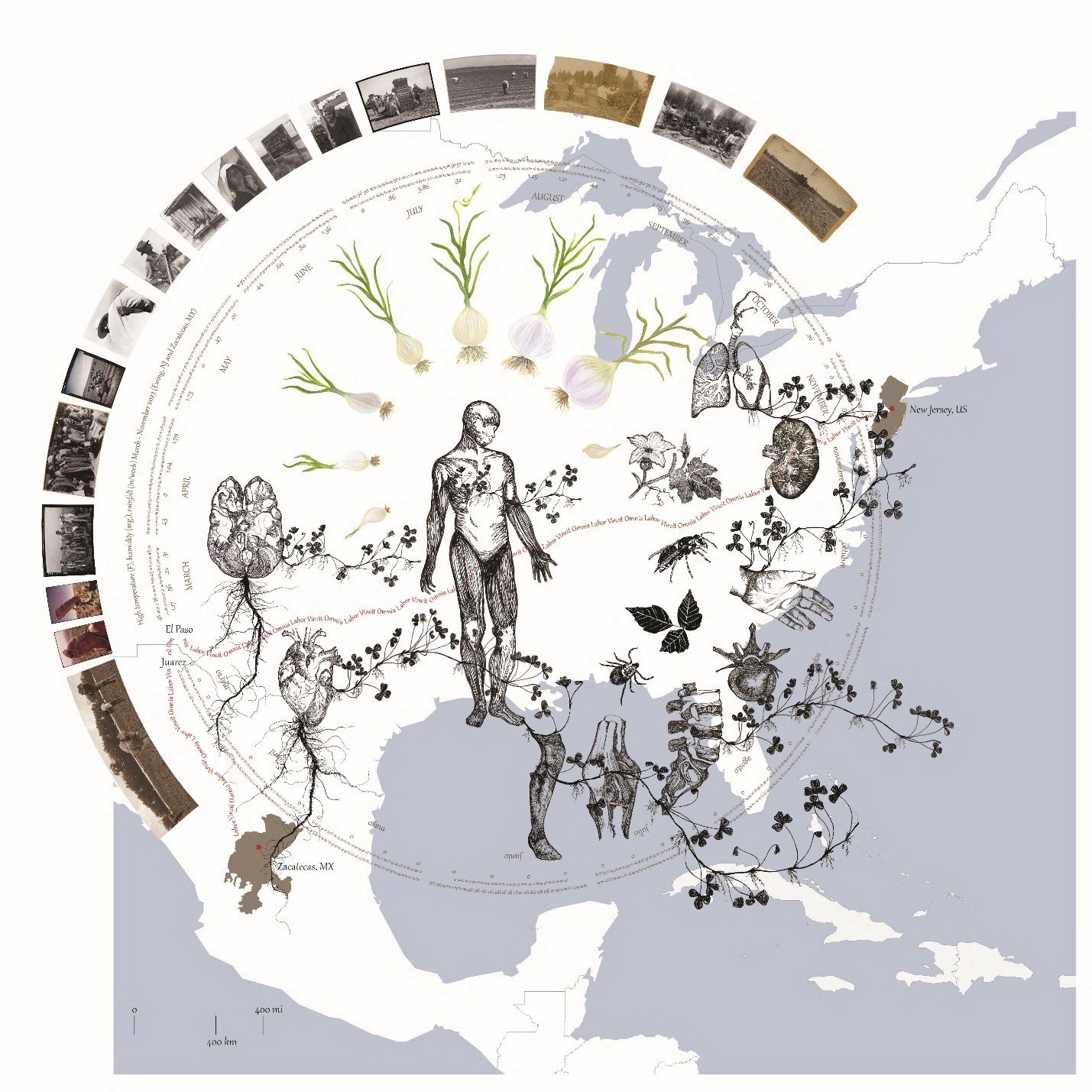
Figure 1. Mapping Migrant Farm Labour, Care, and Diverse Economies in New Jersey's Community Supported Agriculture (Illustration by the author; base map credit: Rutgers Cartography, 2023)
The Coordinates of Garlic
Garlic offered itself as the seed for the map during the labour-intensive harvest of the crop when I learned from one of the farmworkers that where they are from in north-central Mexico, there is an old tradition of wearing, for good luck, a clove of garlic in a small pouch strung about one’s neck. For the CSA farm operator, garlic grown organically can gross nearly double what other crops bring in per bed, and it is often the only seed that the farmer sorts and saves for planting. For both farmer and farmworker,[5] garlic spans two seasons of farm labour, stitching the close of one in early November to the promise of another in early spring.
Garlic, illustrated in its growth cycle, is employed as allegory for CSA as a space and practice of ethical commitments and the promise of community, growth, and care. It also cedes an opening for critical engagement with the literal and metaphorical in/visibility of migrant labour in CSA, as so much of the garlic growth cycle occurs hidden from view.
The months of climate data that surround the garlic cycle mark the passage of time and weather in both New Jersey and Zacatecas and draw attention to the fact that while traditional farmers, and, by extension, their workers, are beholden to localized weather, the men who inhabit class positions[6] of farmworker in the US and ejido farmer in Mexico – class positions that are formally assigned and separated by geographic location, and also fluid – are simultaneously affected by a factor of two climates. (Figure 2)

Figure 2. The growth cycle of garlic framed by climate data recorded in New Jersey and Mexico (Drawings by the author, 2023)
Coordinates of the Body, Dis/located
New Jersey and Mexico become visually linked by the promise of labour omnia vincit. A line, composed of this phrase[7] that adorns the state seal of Zacatecas, traces the route that these migrant farmworkers travel and conveys the experience of being simultaneously located and dislocated by the migratory nature of the work that sustains them. (Figure 3)
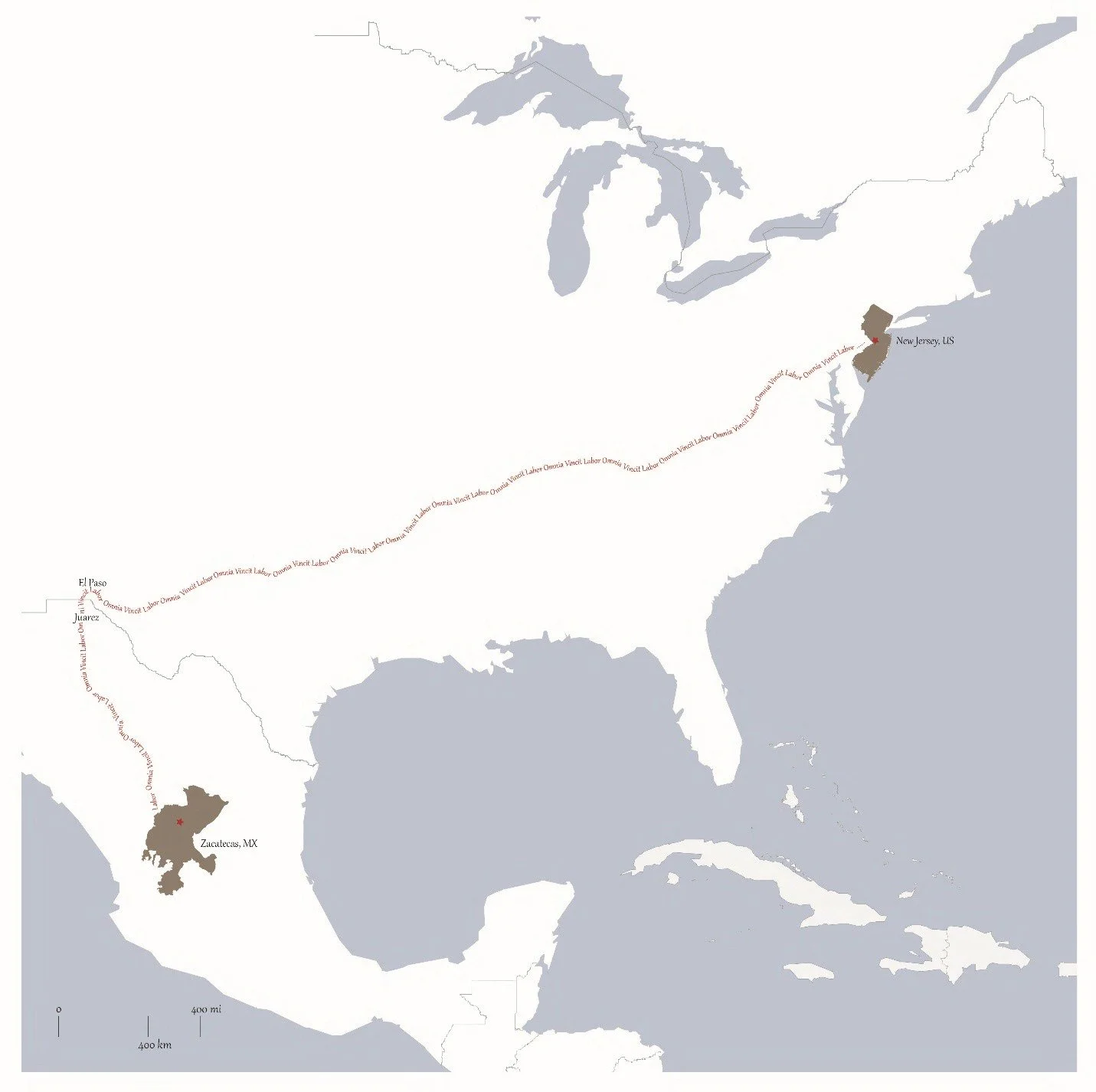
Figure 3. The route that the migrant farmworkers travel between New Jersey and Mexico is marked by the phrase "labor omnia vincit" (Illustration by the author; base map credit: Rutgers Cartography, 2023)
There is an immense physical toll on the body in this manner of farming, which relies little on machinery. Some of it is seen; most of it remains unseen. Heat strains the human heart, lungs, and kidneys to keep core temperatures normal, sometimes damaging those organs and others. Chronic dehydration overloads kidneys and makes the heart work harder. There is overexposure to ultraviolet radiation, tick-borne diseases, and a host of contact irritations. Low back and knee pain are considered normal from cumulative trauma of stooped working postures and heavy lifting.
Anatomical parts are disarticulated from the whole to force the viewer to consider how often the migrant labouring body has been reduced to a kit of anonymous and interchangeable parts. They are also brought outside the body so that we can see and understand (and hopefully begin to care for) that which we do not know. (Figure 4)
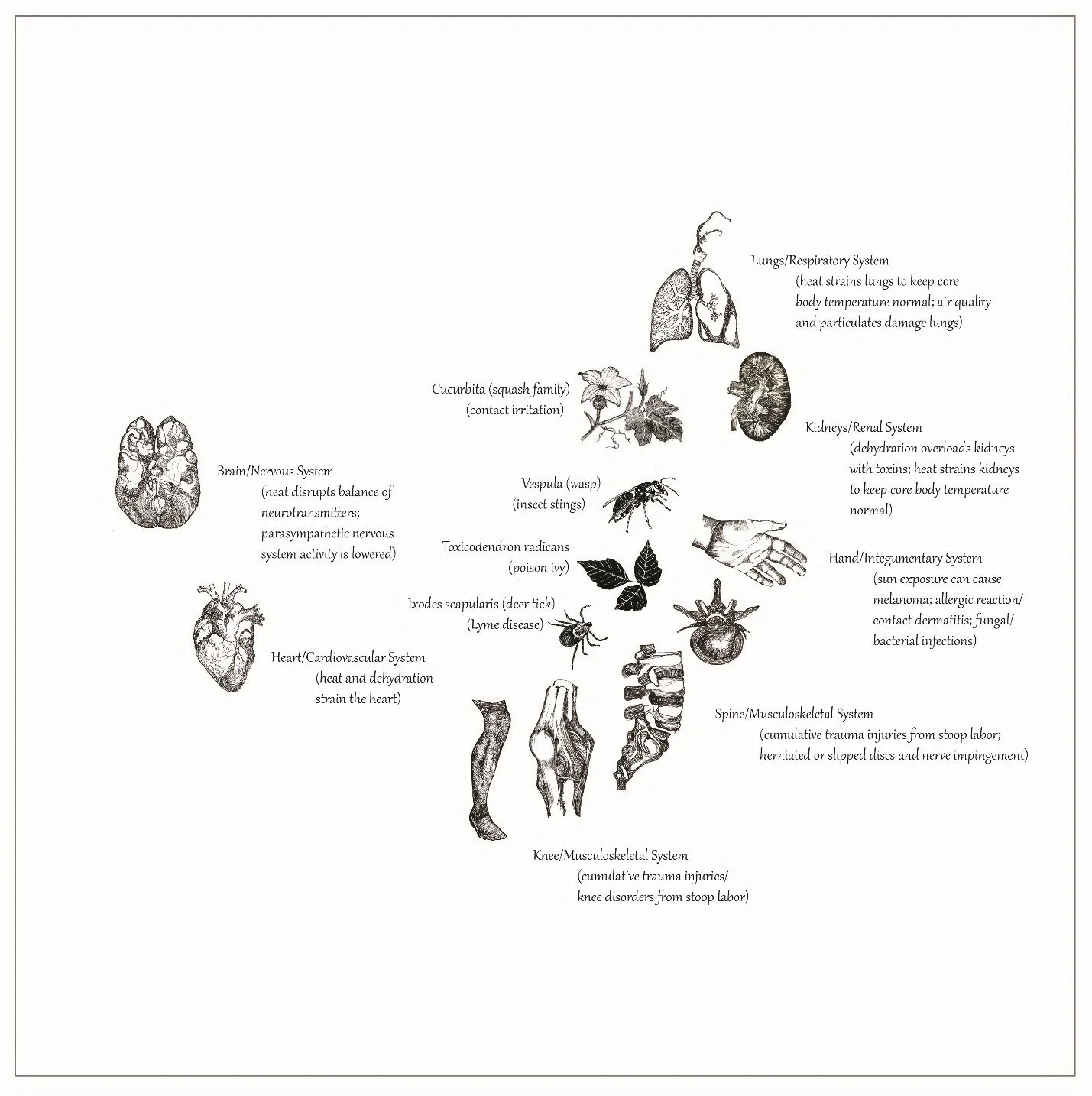
Figure 4. Anatomical parts are disarticulated here to indicate how the physical and emotional body are affected by the nature of this work. (Drawings by the author, 2023)
The work of migration demands additional hard, unpaid labour as well – from the rote, reproductive labour of daily meal preparation to the private emotional labour of maintaining long-distance familial bonds. This here/there tension of the mind and spirit is represented by the brain and the heart organs as objects that are at once symbolic as vehicles for the farmworkers’ knowledge and life-blood – mobile, valued, and extractable – and also tap-rooted in home, to endure. (Figure 5)
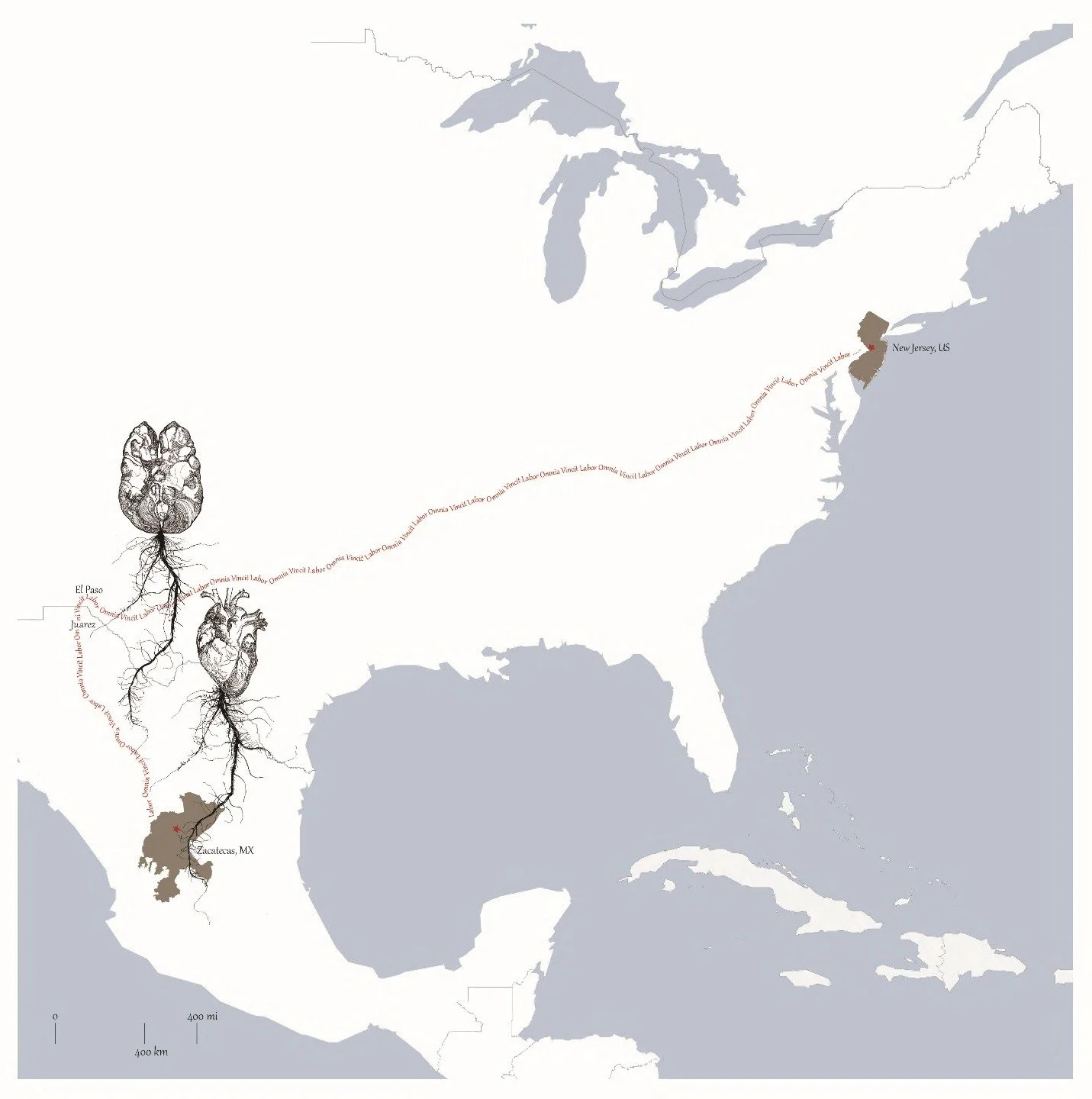
Figure 5. The head and the heart are tap-rooted in home. (Illustration by the author; base map credit: Rutgers Cartography, 2023)
This body narrative is framed within a genealogy of migrant and immigrant labour that has been part and parcel to agricultural practice in the United States from its inception. The arc of historic portraits resists anonymity and asks the viewer to look closely and to recognise the ongoingness of persons who are and have been, with varying degrees of agency, located and dislocated through the work of farming and whose labour and knowledge have often been violently extracted. (Figure 6)
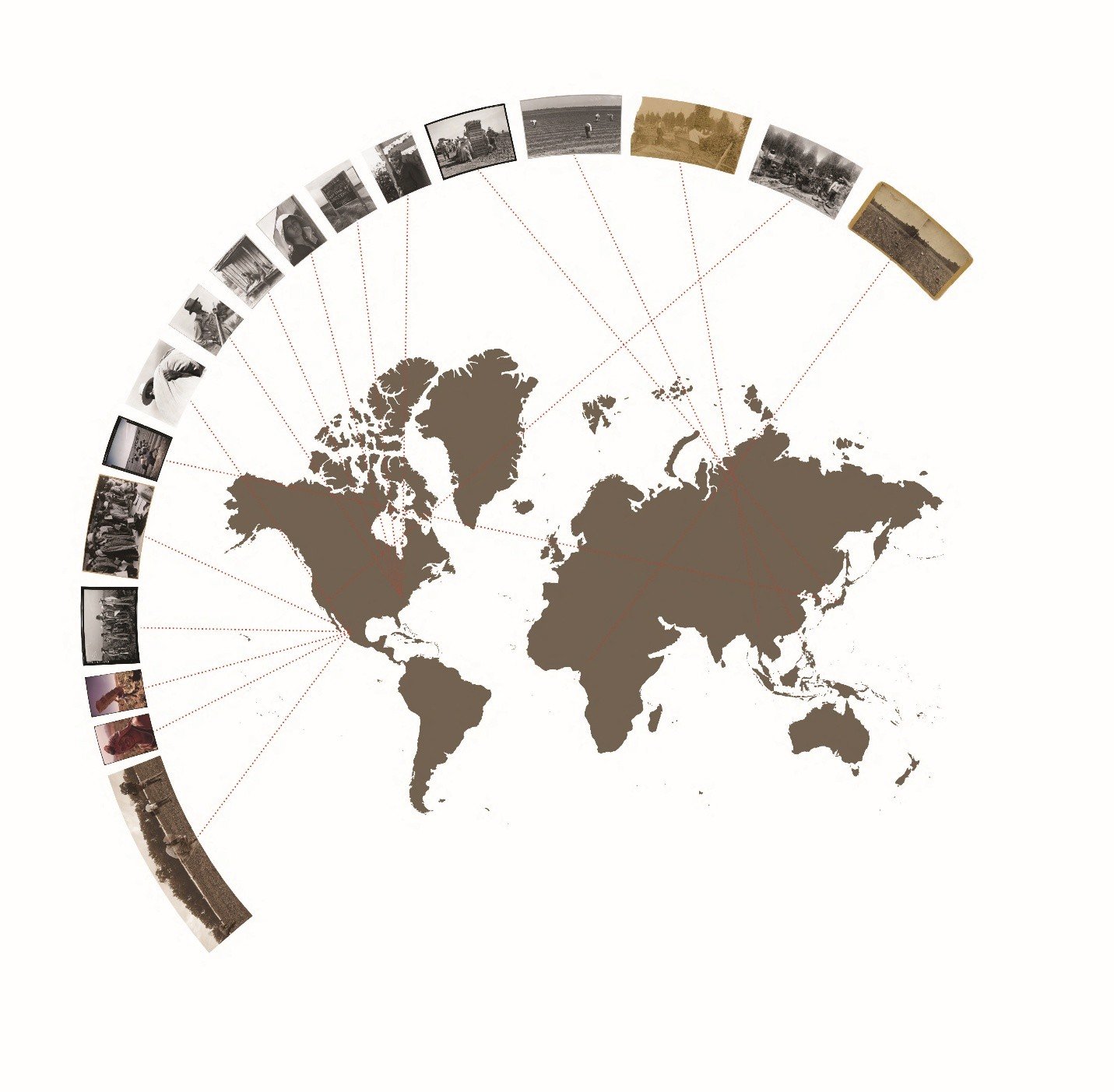
Figure 6. Genealogy of migrant and immigrant labor in the US. (All photographic images are used with no known restrictions and are sourced from the Library of Congress, National Archives, and Wikimedia Commons)
Coordinates of the Body, Rooted
The coordinates of this narrative layer emerged from an iterative and site-specific inventory of labor, enterprise, and transaction that revealed myriad complex, interdependent, and relationally constituted economic engagements in a space that is typically described simply as a locally bounded farmer-to-consumer model. The diverse economic and social relations identified in the CSAs of this study resist many aspects of hegemonic agricultural practice in the twenty-first century and suggest the mutability of capitalist production both despite and because of the farms’ reliance on migrant farmworker labour. To convey these findings cartographically, I employ T. repens (white clover) as a botanical, morphological, and cultural metaphor of overdetermination for the complex set of economic relations within which the migrant farmworker is centred. (Figure 7)
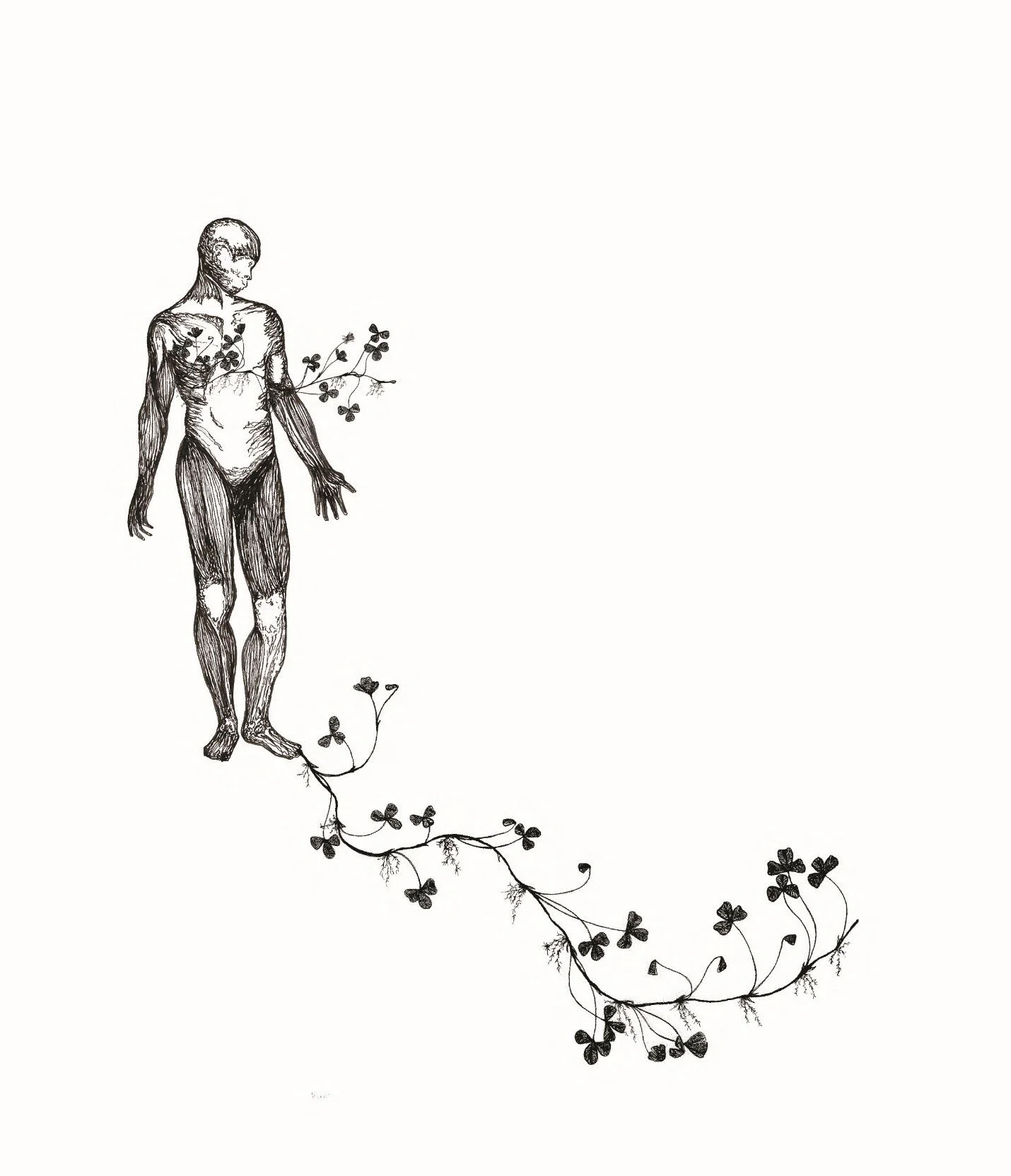
Figure 7. T. repens flows from the body of the migrant farmworker (Drawing by the author, 2023)
T. repens is a naturalised perennial in North America whose productive and prostrate growth habit is made possible by an extensive above-ground system of stolons from which adventitious roots form at each node, allowing a single plant to access nutrients and moisture from a much wider extent than the original taproot is capable. The agricultural significance of T. repens is its ability to fix nitrogen in the soil in a form that other plants can utilise.
The work that T. repens does in its rhizomatic reach across the map is to trace the diverse and community economies made possible by the migrant farmworkers. T. repens fixes possibility in the commons of the CSA and begins to repair the disconnection that remains in a singular reading of CSA as only a site of hyper-local mutual support.
Conclusion
This immersion into the particular impels us to consider the space and practice of CSA as uniquely positioned to place labour at the centre of ethical production and ethical production at the centre of economy, rather than ethical consumption.[8] The map strives to illuminate and invite connection towards further, more wide-reaching repair in a local farm-based economy that is already doing agriculture differently.
About the Author.
Arianna Lindberg, Ph.D is the BSLA and Environmental Planning Program Director and Associate Teaching Professor in the Department of Landscape Architecture, School of Environmental and Biological Sciences, Rutgers, The State University of New Jersey
Endnotes
[1] Two weeks of each month were spent working alongside two farm crews comprised of three migrant workers each. Regarding my own participation in and representation of labour on CSA, the work presented here strives to remain authentic to the experiences of the men with whom I worked, while also recognising the inherent subjectivity of this qualitative research method as an epistemological resource. (David Butz and Kathryn Besio, “Autoethnography,” Geography Compass 3, no. 5 (2009): 1660–74.)
[2] J.K. Gibson-Graham, “Poststructural Interventions,” in A Companion to Economic Geography, ed. Eric Sheppard and Trevor J. Barnes (Blackwell, 2000), 1.
[3] Ibid., 4.
[4] The Community Economies Research Network employs this concept of ethical coordinates to interrogate survival, surplus, transactions, consumption, commons, and investment (https://www.communityeconomies.org/about/community-economies-research-and-practice, accessed 7 July 2026).
[5] The term “farmer” refers to the owner and/or operator of the farm. The term “farmworker” refers to an individual employed on the farm.
[6] I speak of class here in the context of diverse economies scholarship class is understood as an overdetermined process and position, rather than a hierarchical grouping of persons. (Stephen A. Resnick and Richard D. Wolff, Knowledge and Class: A Marxian Critique of Political Economy (The University of Chicago Press, 1987); J.K. Gibson-Graham, The End of Capitalism (As We Knew It): A Feminist Critique of Political Economy (University of Minnesota Press, 2006).)
[7] Translation of the Latin is “work conquers all.” It is a phrase often taken up within the labor movement because it embodies the idea that through collective effort and perseverance, obstacles may be overcome, and goals may be achieved.
[8] Lindsay Naylor, “Fair Trade: Market-Based Ethical Encounters and the Messy Entanglements of Living Well,” in The Handbook of Diverse Economies, ed. J.K. Gibson-Graham and Kelly Dombroski (Edward Elgar Publishing Limited, 2020).